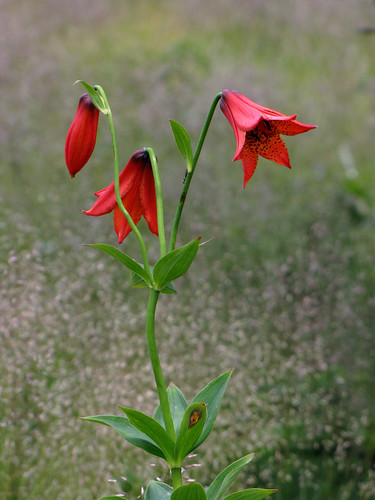
Lilium philadelphicum, also known as the wood lily, Philadelphia lily, prairie lily or western red lily, is a perennial species of lily native to North America. It is widely distributed in much of Canada from British Columbia to Quebec, and parts of the United States (Northeast and Great Lakes regions plus the Rocky and Appalachian Mountains).
 This lily grows to a height of approximately 30 to 90 centimeters, and produces red or orange blooms between June and August.
A variant of the species, the western red lily (L. philadelphicum andinum) was designated Saskatchewan's floral emblem in 1941.It is featured on the flag of Saskatchewan.
This lily grows to a height of approximately 30 to 90 centimeters, and produces red or orange blooms between June and August.
A variant of the species, the western red lily (L. philadelphicum andinum) was designated Saskatchewan's floral emblem in 1941.It is featured on the flag of Saskatchewan.
 The wood lily is listed as endangered in Maryland, New Mexico, Tennessee and North Carolina. Its status is "threatened" in Kentucky and Ohio. In Saskatchewan, the flower is protected under the Provincial Emblems and Honours Act, meaning it cannot be picked, uprooted or destroyed in any way.
Lilium grayi (Gray's lily, Orange bell lily, Roan lily) is a perennial plant that is endemic to the Eastern USA states of North Carolina, Virginia, and Tennessee, growing in moist, acid soil in the Appalachian mountains on higher elevation meadows, bogs, and seeps. The plant was introduced to Royal Botanic Gardens, Kew in 1890 and was featured in the Kew Bulletin in 1892.
 The species was named to honor Asa Gray, an eminent American botanist of the mid-19th century who discovered Lilium grayi in 1840 in the Appalachian mountains on Roan Mountain. At the time, Gray wasn't sure that it was a unique species, thinking that it might be a variety of Lilium canadense. He found more plants there in 1879 on a trip with Charles Sprague Sargent. Sereno Watson, curator at the Gray Herbarium of Harvard University, found several differences from Lilium canadense, confirming that it was a distinct species, and named the plant in honor of his colleague.
Lilium grayi reaches 2 to 5 ft (0.61 to 1.52 m) tall. The 2 to 3 in (5.1 to 7.6 cm) leaves are lanceolate to oblong-lanceolate and carried around the stem in whorls. The 2.5 in (6.4 cm) reddish-orange bell-shaped flowers bloom in early summer and are carried on several umbels in a tiered style. Sepals and petals have purple spots.
 Lilium grayi is native to mountainous regions in only three U.S. states: North Carolina, Virginia, and Tennessee. It grows in sandstone and acidic soils, meadows, open areas near summits, forest meadows, and bluff outcrops. It grows in full sunlight. Habitat is threatened by overgrazing by cattle, European wild boars, and rabbits. Increase of tree canopy also decreases available open habitat. The plant has also been reduced by illegal collecting and is susceptible to fungal infections.

Lilium canadense, commonly called either the Canada Lily, Wild Yellow-Lily, or the Meadow Lily, is a native of eastern North America. Its native range extends from Ontario to Nova Scotia south to Georgia and Alabama. It is most common in New England, the Appalachian Mountains, and the Canadian Maritimes. It is also cultivated as an ornamental in Europe and other places.
 Flowers emerge in June. They are nodding (hanging downward), yellow, orange or red, often with darker spots. The plant has become less common in urban and suburban areas due to heavy browsing by the white-tailed deer.
Habitat: moist meadows, wood margins • Height: 0.5-1.5 metres
Flower size: 50-75 mm wide
Flower color: yellow, orange, or red
Flowering time: June to July
Origin: native
The flower buds and roots were once gathered and eaten by North American indigenous peoples.
Flowers emerge in June. They are nodding (hanging downward), yellow, orange or red, often with darker spots. The plant has become less common in urban and suburban areas due to heavy browsing by the white-tailed deer.
Habitat: moist meadows, wood margins • Height: 0.5-1.5 metres
Flower size: 50-75 mm wide
Flower color: yellow, orange, or red
Flowering time: June to July
Origin: native
The flower buds and roots were once gathered and eaten by North American indigenous peoples.

Lilium michauxii, commonly known as the Carolina lily can be found in the Southeastern United States from southern Virginia in the north to the Florida Panhandle in the south to eastern Texas in the west. It is most common in July and August but can be found blooming as late as October. It was named for the French botanist André Michaux, who traveled and did extensive research throughout the Southeast.
The common name "Carolina lily" reflects an older taxonomy that used the name Lilium carolinianum for both L. michauxii and L. catesbaei. Another common name, Turk's cap lily, has been listed for L. michauxii, although L. superbum (which is very similar in appearance to L. michauxii) shares this common name.
The C arolina lily can grow to 3½ feet tall with flowers 3–4 inches across. It is the only fragrant lily east of the Rocky Mountains. Its petals bend backward and are spotted. Colors range from yellow through orange to red for background petal color and from red through purple to brown for the spots.
 The Carolina lily is the official state wildflower of North Carolina.
Cardiocrinum giganteum, the giant Himalayan lily, is the largest species of any of the lily plants, growing up to 3.5 meters high. It is found in the Himalayas, China and Myanmar (Burma).
The plant was first described scientifically in 1824 by Nathaniel Wallich. The species was introduced into commercial production (as Lilium giganteum) in Britain in the 1850s. A bulb grown from seed collected by Major Madden flowered in Edinburgh in July 1852, while those collected by Thomas Lobb were first exhibited in flower in May 1853.
Cardiocrinum giganteum has been well established in cultivation in England for well over a century.
 Given the rarity of these plants in eastern North American gardens, it's hard to believe, but Peter Hanson grew C. giganteum in Brooklyn, New York, USA during the second half of the nineteenth century. Although originally introduced long ago, C. cordatum and C. cathayanum have only recently become readily available.
Generations of writers have repeated the incorrect notion that these plants are monocarpic. They are not monocarpic. Yes, the flowering stems die after seed set; in fact, they die whether seed is set or not. But so do the fruiting stems of tulips, lilies, fritillaries and a host of other similar plants. The perennial stem (i.e. the basal plate) and its offset bulbs live on from year to year.
A relaxed approach used by Stephen J. Vinisky to germinating seeds is to sow them in a 5 1/2 inch "azalea" pot. He uses a 1/3 grit mixture. The pot size holds about 18 seeds comfortably. After sowing on the surface of the firmed mix, top the seeds with 1/4" of chicken grit. The pots go outside (under the eaves of the house in a shady, eastern exposure to keep off the majority of our almost continuous rain) and are subject to whatever the winter weather provides. In late spring, the seeds put up one very tiny leaf that attracts every slug and snail for miles around. Sluggo is a less toxic way to effectively keep slugs away.
A more active approach is to sow seeds in good potting mix, water and place in a plastic bag at 55-65 °F (13-18 °C) for 2-3 weeks. Then place in the fridge to stratify for 4-6 weeks and return to germination temperature. Remove from the plastic bag and keep the mix moist. Germination can be very slow.
Given the rarity of these plants in eastern North American gardens, it's hard to believe, but Peter Hanson grew C. giganteum in Brooklyn, New York, USA during the second half of the nineteenth century. Although originally introduced long ago, C. cordatum and C. cathayanum have only recently become readily available.
Generations of writers have repeated the incorrect notion that these plants are monocarpic. They are not monocarpic. Yes, the flowering stems die after seed set; in fact, they die whether seed is set or not. But so do the fruiting stems of tulips, lilies, fritillaries and a host of other similar plants. The perennial stem (i.e. the basal plate) and its offset bulbs live on from year to year.
A relaxed approach used by Stephen J. Vinisky to germinating seeds is to sow them in a 5 1/2 inch "azalea" pot. He uses a 1/3 grit mixture. The pot size holds about 18 seeds comfortably. After sowing on the surface of the firmed mix, top the seeds with 1/4" of chicken grit. The pots go outside (under the eaves of the house in a shady, eastern exposure to keep off the majority of our almost continuous rain) and are subject to whatever the winter weather provides. In late spring, the seeds put up one very tiny leaf that attracts every slug and snail for miles around. Sluggo is a less toxic way to effectively keep slugs away.
A more active approach is to sow seeds in good potting mix, water and place in a plastic bag at 55-65 °F (13-18 °C) for 2-3 weeks. Then place in the fridge to stratify for 4-6 weeks and return to germination temperature. Remove from the plastic bag and keep the mix moist. Germination can be very slow.
 Transplant seedlings when they're large enough to handle. Both seedlings and adults should be grown in part sun with plenty of moist and organic rich soils (much like conditions for growing hostas). A little fertilizer is recommended during the growing season.
Lilium maritimum is a species of lily known by the common name coast lily. It is endemic to California, where it is known only from the coastline north of San Francisco. It formerly occurred south of San Francisco; these occurrences have all been extirpated. The species is now restricted to the North Coast from Marin County to Del Norte County, and is most common in Mendocino County. It grows in the California coastal prairie habitat, coniferous forests, and bogs amongst Drosera species.
It is also found in scrub, fens, or gaps in the closed-cone forests, usually in low places where it stays wet longer. We have garden plants, but it is found in the wild near us and that is where the first two pictures were taken by Bob Rutemoeller. The next two by Mary Sue Ittner were taken of plants in the road verges. The fifth was taken by Ron Moodycliffe in a paddock near Ft. Bragg, California and the last by Ron Parsons Sonoma County, California. Germination is cool hypogeal, small bulbs are formed in winter and leaves appear in spring.
 Lilium maritimum is a perennial herb usually exceeding a meter in height and known to exceed two meters at times. Specimens from coastal bluffs and similar harsh habitats are much smaller. The plant grows from a scaly, elongated bulb several centimeters long. The oval leaves are mostly basal, with some located in several whorls about the stem. They may reach 18 centimeters long
 The inflorescence bears up to 13 large, nodding flowers. The flower is bell-shaped with 6 tepals with tips recurved or curled tightly back. The tepals are up to 5 centimeters long and red to orange, usually with spots. There are 6 stamens with large red anthers sometimes over a centimeter long, and a pistil which may be over 3 centimeters in length.
Jaltomata procumbens is a plant species native to Mexico, Central America, Colombia, Ecuador, Peru, and Venezuela. It grows as a weed in agricultural fields and other disturbed locations, but in many places the people protect it because of the edible fruits it produces.
 Jaltomata procumbens is a spreading, trailing to ascending herb forming many shoots from a single root. Leaves are broadly lanceolate, up to 20 cm long, dark green. Flowers are rotate, pale yellow-green with darker green spots toward the center. Berries are dark purple, spherical, about 1 cm in diameter, with a strong scent resembling that of grapes (Vitis spp.).
 The fruit has a pleasant taste and aroma and is prized as a food source by many peoples. The Tarahumara and Pima Bajo (Mountain Pima) peoples of the Sierra Madre Occidental of northwestern Mexico recognize the species when it grows in their agricultural fields, but protect it and encourage its growth. Many crop historians believe that many other species now recognized as crops began the process of domestication under similar circumstances, as volunteers in fields planted to other species.

Petunia exserta is a rare member of the genus Petunia, endemic to the Serras de Sudeste in southern Brazil. First described in 1987, only fourteen plants were found in the wild during an expedition in 2007. In the wild, the plant is found growing only in shaded cracks on sandstone towers. It is the only Petunia species that is naturally pollinated by hummingbirds, and the only red flowered Petunia species.
 P. exserta has a bright red corolla with distinctive exserted stamens and stigma, the latter which are typically associated with hummingbird pollination. It share the erect habit, and similar corolla, pollen, and stalk attributes as Petunia axillaris and Petunia secreta. The flowers have no fragrance, which is not necessary for attracting hummingbirds, who have little sense of smell. The red color is due to several anthocyanin pigments, which are different from the cause of red color in modern hybrid petunias.
 In addition to its very limited range, P. exserta is also threatened because it so easily hybridizes with other Petunia species in its native range, especially with Petunia axillaris, thus producing offspring that are hybrids rather than the species. The plant is increasingly being sold in horticulture, so the threat to its survival is only in its native habitat.
Cestrum parqui, commonly known as green cestrum, green poison berry, Chilean cestrum or willow-leaved jessamine, and is sometimes incorrectly referred to as deadly nightshade, is a species of flowering plant in the family Solanaceae that is native to central and South America.
 It is an upright, straggly, woody deciduous or semi-evergreen shrub 2–3 metres (6 ft 7 in–9 ft 10 in) tall with one or more brittle green stems. Light green leaves are alternate and shiny green to 12 cm (5 in) long, giving off a foul rubbery smell when crushed. It has sprays of small, fragrant, tubular yellow-green flowers approximately 2.5 cm long on the ends of the stems, flowering from late spring to autumn. These produce clusters of small, black egg shaped berries during summer to autumn.
Green cestrum is highly attractive to birds, and seedlings are often found growing under perching trees, along fence lines and on creek banks. It is also dispersed by water.
Spread by birds, it invades gardens, rural lands and bushland. It has a deep and persistent taproot. This weed is considered a major problem because of its toxicity to livestock (especially cattle) and poultry which eat green cestrum when there is a shortage of other feed. All parts of the plant material, stems, leaves, berries and even partly burnt roots pose a serious threat to livestock. Death is usually rapid and painful. The plant is also known to be toxic to other livestock and humans.
It is an upright, straggly, woody deciduous or semi-evergreen shrub 2–3 metres (6 ft 7 in–9 ft 10 in) tall with one or more brittle green stems. Light green leaves are alternate and shiny green to 12 cm (5 in) long, giving off a foul rubbery smell when crushed. It has sprays of small, fragrant, tubular yellow-green flowers approximately 2.5 cm long on the ends of the stems, flowering from late spring to autumn. These produce clusters of small, black egg shaped berries during summer to autumn.
Green cestrum is highly attractive to birds, and seedlings are often found growing under perching trees, along fence lines and on creek banks. It is also dispersed by water.
Spread by birds, it invades gardens, rural lands and bushland. It has a deep and persistent taproot. This weed is considered a major problem because of its toxicity to livestock (especially cattle) and poultry which eat green cestrum when there is a shortage of other feed. All parts of the plant material, stems, leaves, berries and even partly burnt roots pose a serious threat to livestock. Death is usually rapid and painful. The plant is also known to be toxic to other livestock and humans.

This species is defined as a noxious plant in New South Wales under the Noxious Weeds Act, 1993 and all plants must be destroyed.
In cultivation in the United Kingdom, this plant has gained the Royal Horticultural Society's Award of Garden Merit.
Scindapsus pictus (satin pothos, silver vine) is a species of flowering plant in the arum family Araceae, native to Bangladesh, Thailand, Peninsular Malaysia, Borneo, Java, Sumatra, Sulawesi, and the Philippines.
 Growing to 3 m (10 ft) tall in open ground, it is an evergreen climber. On juvenile plants the leaves are oval and entire; on mature plants the leaves are pinnately lobed. They are matt green and covered in silver blotches. The insignificant flowers are rarely seen in cultivation.
 The specific epithet pictus means "painted", referring to the variegation on the leaves.
With a minimum temperature tolerance of 15 °C (59 °F), this plant is cultivated as a houseplant in temperate regions, where it typically grows to 90 cm (35 in). The cultivar 'Argyraeus' has gained the Royal Horticultural Society's Award of Garden Merit.
The specific epithet pictus means "painted", referring to the variegation on the leaves.
With a minimum temperature tolerance of 15 °C (59 °F), this plant is cultivated as a houseplant in temperate regions, where it typically grows to 90 cm (35 in). The cultivar 'Argyraeus' has gained the Royal Horticultural Society's Award of Garden Merit.
All peace lilies are evergreen tender perennials. Most have upright clusters of leaves that grow directly from short rhizomes (underground rooting stems) to form slow-spreading clumps. The shiny, simple bright green leaves have long, sheathed petioles (leaf stems) and prominent leaf veins. They vary in shape from narrowly lanceolate to elliptical or oval with pointy tips.
 Like all members of the aroid family, they have unusual flowers consisting of a finger-like floral column (spadix) surrounded by a white or pale green petal-like leaf (spathe). The spathe is often large, leathery and held above the foliage. The blooms are usually fragrant, long lasting and suitable for cutting. They occur mostly from winter to summer, but some hybrids have been bred to bloom longer.
Tropicals such as these are very frost-tender and require protection from chilly weather. Bright indirect light, high humidity and evenly moist but well-drained soil or potting mix are required for good growth. Water and fertilize regularly, but refrain from over-watering or over-feeding as both can damage root and foliage health. Outdoor plants must be shaded from intense midday sun, which can scorch leaves. Indoors, these are some of the best plants for low-light conditions. Spathiphyllums are great landscape plants for the tropics. In temperate areas grow them as houseplants or summer patio specimens.
Symplocarpus foetidus, commonly known as skunk cabbage or eastern skunk cabbage (also swamp cabbage, clumpfoot cabbage, or meadow cabbage, foetid pothos or polecat weed), is a low growing, foul-smelling plant that grows in wetlands of eastern North America.
 Eastern skunk cabbage has leaves which are large, 40–55 cm (15.75–21.5 in) long and 30–40 cm (12–15.75 in) broad. It flowers early in the spring when only the flowers are visible above the mud. The stems remain buried below the surface of the soil with the leaves emerging later. The flowers are produced on a 5–10 cm (2–5 in) long spadix contained within a spathe, 10–15 cm (4–6 in) tall and mottled purple in colour. The rhizome is often 30 cm (1 ft) thick.
The eastern skunk cabbage is native to eastern North America, from Nova Scotia and southern Quebec west to Minnesota, and south to North Carolina and Tennessee. It is protected as endangered in Tennessee.
 Breaking or tearing a leaf produces a pungent but not harmful odor, the source of the plant's common name; it is also foul smelling when it blooms. The plant is not poisonous to the touch. The foul odor attracts its pollinators, scavenging flies, stoneflies, and bees. The odor in the leaves may also serve to discourage large animals from disturbing or damaging this plant which grows in soft wetland soils.
 Eastern skunk cabbage is notable for its ability to generate temperatures of up to 15–35 °C (27–63 °F) above air temperature by cyanide resistant cellular respiration in order to melt its way through frozen ground, placing it among a small group of plants exhibiting thermogenesis. Even though it flowers while there is still snow and ice on the ground it is successfully pollinated by early insects that also emerge at this time. Some studies suggest that beyond allowing the plant to grow in icy soil, the heat it produces may help to spread its odor in the air.
Erigeron glaucus is a species of flowering plant in the daisy family known by the common name seaside fleabane, beach aster, or seaside daisy.
This wildflower is native to the coastline of Oregon and California where it grows on beaches, coastal bluffs and dunes. This is a perennial daisy reaching heights between 5 and 30 centimetres (2.0 and 11.8 in) with branching, nodding stems which may be glandular and hairy to hairless. It grows from a stout rhizome and produces thick, firm, rounded to spoon-shaped leaves, sometimes with a few teeth along the edges, each two to 13 centimeters long.
 Its stems bear inflorescences of one to 15 flower heads which are variable in size from one to over three centimeters wide. The centers contain golden yellow disc florets and the edges are fringed with ray florets which may be long or quite short, and are shades of deep blue and purple to nearly white. While typical habitats include coastal bluffs, one highly specialised plant association is found within the two Cupressus macrocarpa dominant forests in Monterey County, California.
Coreopsis auriculata (Mouse-ear Tickseed) is a plant species of the genus coreopsis in Asteraceae. Coreopsis species are commonly called Tickseeds. This species is perennial growing from 10–30 cm (4-12 inches) tall and sometimes to 60+ cm (30 inches). Pants with rounded yellow colored flowers bloom in spring and early summer. They are often stoloniferous, forming long spreading colonies by way of short stolons produced after flowering. Plants produce both basal and cauline leaves; the foliage occupy 1/4–1/2 of the plant height, the leaves have petioles 1–6(–10+) cm long, with simple leaf blades or they sometimes have 1 or 2, or more lateral lobes.
 The basal leaf blades are suborbiculate or ovate-elliptic to lance-ovate in shape and typically 15–55 mm long and 9–25 mm wide. Flower heads are produced on the ends of 8 to 25 cm long peduncles, the heads have 9–12 mm long phyllaries that are lance-deltate to lance-ovate in shape. The flower petals or more properly the ray laminae are yellow colored and 15–20+ mm long. The disc flowers have corollas 3.5–4.5 mm long with yellow colored apices. Cypselae or the fruits containing a single seed are 1.5–2.5 mm long and brown black in color with no wings.
 Plants are found growing along roadsides and in openings in woods with mixed hardwood trees and pine barrens especially with calcareous soils in the south eastern USA. Coreopsis auriculata 'Nana' is commonly grown as a blooming ground cover in garden settings.
Pteridium aquilinum (bracken, brake or common bracken), also known as "eagle fern," is a species of fern occurring in temperate and subtropical regions in both hemispheres. The extreme lightness of its spores has led to its global distribution.
 Common bracken was first described as Pteris aquilina by the father of taxonomy, Carl Linnaeus, in Volume 2 of his Species Plantarum in 1753. The origin of the specific epithet derived from the Latin aquila "eagle", but what it pertains to has been a matter of some debate. It is generally held to be the shape of the mature fronds appearing akin to an eagle's wing. However, medieval scholars, including Erasmus, thought the pattern of the fibres seen in a transverse section of the stipe resembled a double-headed eagle or oak tree. It was given its current binomial name by Friedrich Adalbert Maximilian Kuhn in 1879.
It was traditionally treated as the sole species in the genus Pteridium (brackens); authorities have split and recognised up to 11 species in the genus, however.
It is a herbaceous perennial plant, deciduous in winter. The large, roughly triangular fronds are produced singly, arising upwards from an underground rhizome, and grow to 1–3 m (3–10 ft) tall; the main stem, or stipe, is up to 1 cm (0.4 in) diameter at the base.
 An adaptable plant, it readily colonises disturbed areas. It can even be invasive in countries where it is native, such as England, where it has invaded heather (Calluna vulgaris (L.) Hull) stands on the North Yorkshire moors.
The plant contains the carcinogenic compound ptaquiloside, and communities (mainly in Japan) where the young stems are used as a vegetable have some of the highest stomach cancer rates in the world. Consumption of ptaquiloside-contaminated milk is thought to contribute to human gastric cancer in the Andean states of Venezuela.
An adaptable plant, it readily colonises disturbed areas. It can even be invasive in countries where it is native, such as England, where it has invaded heather (Calluna vulgaris (L.) Hull) stands on the North Yorkshire moors.
The plant contains the carcinogenic compound ptaquiloside, and communities (mainly in Japan) where the young stems are used as a vegetable have some of the highest stomach cancer rates in the world. Consumption of ptaquiloside-contaminated milk is thought to contribute to human gastric cancer in the Andean states of Venezuela.
Matteuccia struthiopteris (common names ostrich fern, fiddlehead ferns or shuttlecock fern) is a crown-forming, colony-forming fern, occurring in temperate regions of the Northern Hemisphere in eastern and northern Europe, northern Asia and northern North America. The species epithet struthiopteris comes from Ancient Greek words, struthio meaning ostrich and pteron meaning wing.
Ostrich Fern Foliage
It grows from a completely vertical crown, favoring riverbanks and sandbars, but sends out lateral stolons to form new crowns. It thus can form dense colonies resistant to destruction by floodwaters.
The fronds are dimorphic, with the deciduous green sterile fronds being almost vertical, 100–170 cm (39–67 in) tall and 20–35 cm (7.9–13.8 in) broad, long-tapering to the base but short-tapering to the tip, so that they resemble ostrich plumes, hence the name. The fertile fronds are shorter, 40–60 cm (16–24 in) long, brown when ripe, with highly modified and constricted leaf tissue curled over the sporangia; they develop in autumn, persist erect over the winter and release the spores in early spring.
 The ostrich fern is a popular ornamental plant in gardens. It has gained the Royal Horticultural Society's Award of Garden Merit. While choosing a place of planting it should be taken into account that these ferns are very expansive and its leaves often lose their beauty throughout the summer, especially if not protected from wind and hail. The tightly wound immature fronds, called fiddleheads, are also used as a cooked vegetable, and are considered a delicacy mainly in rural areas of northeastern North America. It is not considered advisable to eat uncooked fiddleheads because illness has been traced to that practise.

Cyathea cooperi is a medium-to-large fast growing tree fern, to 15 metres (49 ft) in height with a 12-inch (30 cm) thick trunk. The apex of the trunk and unfurling crosiers are particularly attractive, covered as they are with conspicuous long, silky, straw colored scales. The crown is widely spread and the light green fronds may reach a length of 4–6 metres (13–20 ft).
C. cooperi is quite distinctive from C. australis in that it has a more slender trunk with distinctive "coin spots" where old fronds have broken off the trunk. C. cooperi fronds are bright green and lacy and tend to be very fast growing. There are several major horticultural varieties of this fern including Cyathea ‘Brentwood’ which has paler fronds and scales and C. ‘Robusta’ which tends to be darker in both characters. C. cooperi is the one of the most popular tree ferns, along with Dicksonia antarctica due to its rapid growth form, hardiness and aesthetic appeal.
 Tree-ferns grow best in high humidity and high soil moisture conditions. It is therefore important to use good-quality mulches and to top them up regularly as this will not only keep the soil moist but also provide nutrients to the shallow root system. Tree-ferns usually respond well to organic fertilizers and well-rotted animal manures, C. cooperi especially as it tends to display particularly vigorous growth.
 Though a wide range of pests attack ferns they rarely cause significant damage. If outbreaks do occur tree-ferns can be treated with the standard array of organic and non-organic pesticides. It has been found that the use of fertilizers can reduce a tree-ferns susceptibility to attack. Thus by providing adequate food, water and shelter you will be able to grow beautiful and healthy tree-ferns in your own garden!
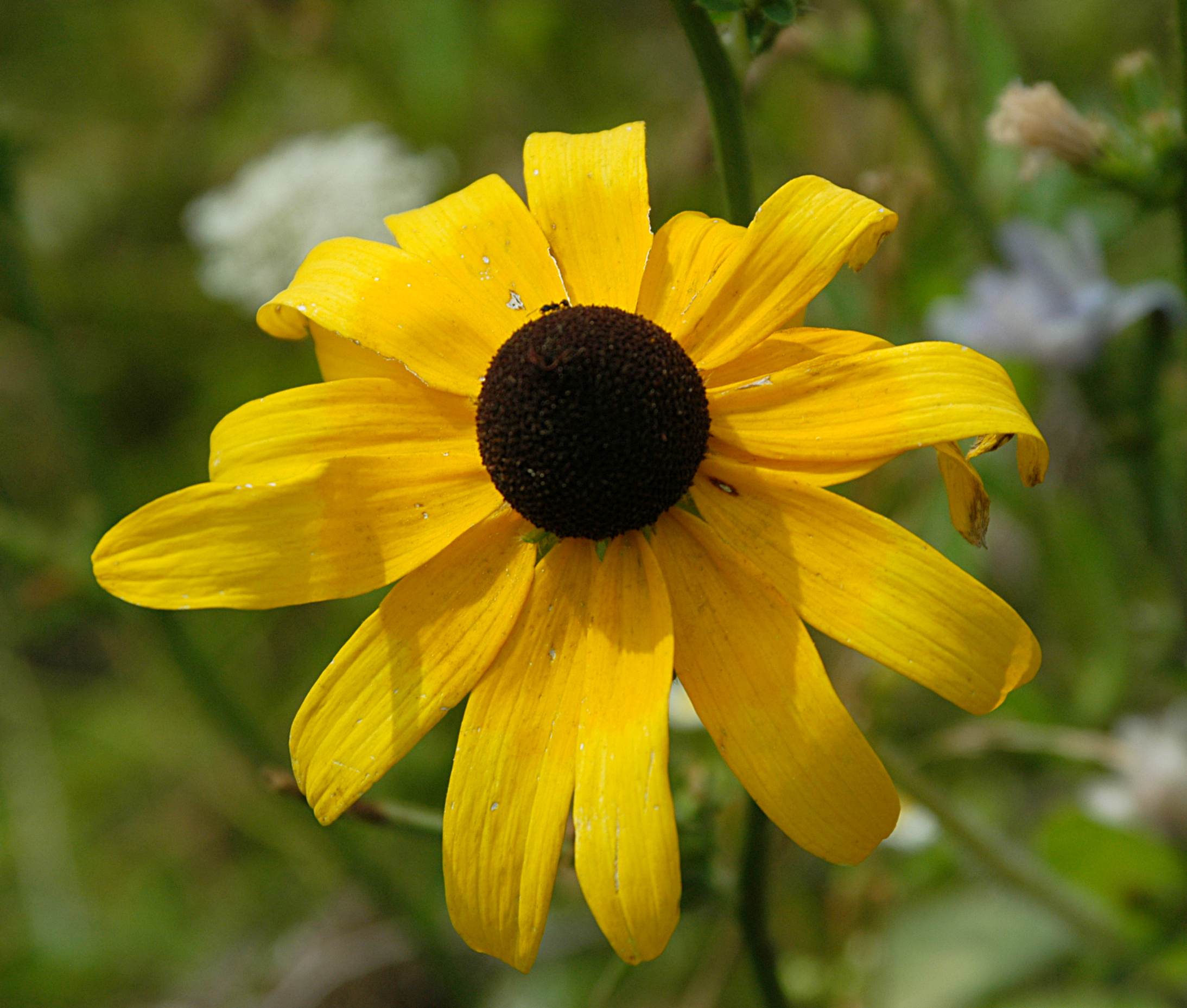
Rudbeckia hirta, commonly called black-eyed Susan, is a species of flowering plant in the family Asteraceae, native to the Eastern and Central United States. It is one of a number of plants with the common name black-eyed Susan. Other common names for this plant include: brown-eyed Susan, brown Betty, gloriosa daisy, golden Jerusalem, Poorland daisy, yellow daisy, and yellow ox-eye daisy.
It is the state flower of Maryland.
The plant also is a traditional Native American medicinal herb in several tribal nations; believed in those cultures to be a remedy, among other things, for colds, flu, infection, swelling and (topically, by poultice) for snake bite (although not all parts of the plant are edible)
Parts of the plant have nutritional value. Other parts are not edible.
 R. hirta is widely cultivated in parks and gardens, for summer bedding schemes, borders, containers, wildflower gardens, prairie-style plantings and cut flowers. Numerous cultivars have been developed, of which 'Indian Summer'and 'Toto' have gained the Royal Horticultural Society's Award of Garden Merit. Other popular cultivars include 'Double Gold' and 'Marmalade'.
Gloriosa daisies are tetraploid cultivars having much larger flowers than the species, often doubled or with contrasting markings on the petals. They were first bred by Alfred Blakeslee of Smith College by applying colchicine to R. hirta seeds; Blakeslee's stock was further developed by W. Atlee Burpee and introduced to commerce at the 1957 Philadelphia Flower Show. Gloriosa daisies are generally treated as annuals or short-lived perennials and are typically grown from seed, though there are some named cultivars.
R. hirta is widely cultivated in parks and gardens, for summer bedding schemes, borders, containers, wildflower gardens, prairie-style plantings and cut flowers. Numerous cultivars have been developed, of which 'Indian Summer'and 'Toto' have gained the Royal Horticultural Society's Award of Garden Merit. Other popular cultivars include 'Double Gold' and 'Marmalade'.
Gloriosa daisies are tetraploid cultivars having much larger flowers than the species, often doubled or with contrasting markings on the petals. They were first bred by Alfred Blakeslee of Smith College by applying colchicine to R. hirta seeds; Blakeslee's stock was further developed by W. Atlee Burpee and introduced to commerce at the 1957 Philadelphia Flower Show. Gloriosa daisies are generally treated as annuals or short-lived perennials and are typically grown from seed, though there are some named cultivars.
Lavandula angustifolia (lavender or English lavender, though not native to England; also common lavender, true lavender, narrow-leaved lavender), formerly L. officinalis, is a flowering plant in the family Lamiaceae, native to the western Mediterranean, primarily the Pyrenees and other mountains in northern Spain.
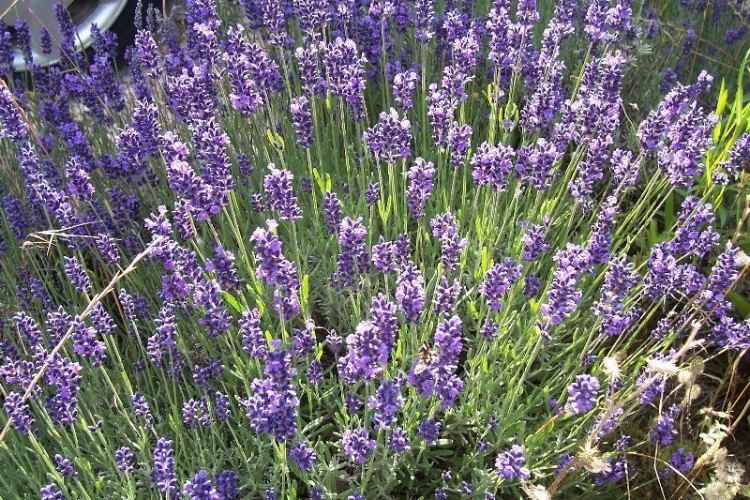 It is a strongly aromatic shrub growing as high as 1 to 2 metres (3.3 to 6.6 ft) tall. The leaves are evergreen, 2–6 centimetres (0.79–2.36 in) long, and 4–6 millimetres (0.16–0.24 in) broad. The flowers are pinkish-purple (lavender-coloured), produced on spikes 2–8 cm (0.79–3.15 in) long at the top of slender, leafless stems 10–30 cm (3.9–11.8 in) long.
English lavender is commonly grown as an ornamental plant. It is popular for its colourful flowers, its fragrance and its ability to survive with low water consumption. It does not grow well in continuously damp soil. It is fairly tolerant of low temperatures, generally considered hardy to USDA zone 5. It tolerates acid soils but favours neutral to alkaline soils. In some conditions it can be short-lived.
 The flowers and leaves are used as an herbal medicine,either in the form of lavender oil or as an herbal tea. The flowers are also used as a culinary herb, most often as part of the French herb blend called herbes de Provence.
Lavender essential oil, when diluted with a carrier oil, is commonly used as a relaxant with massage therapy. Products for home use, such as lotions, eye pillows (including lavender flowers or the essential oil itself) and bath oils, etc., are also used. Both the petals and the oil are the most popular ingredients in handmade soap.
The flowers and leaves are used as an herbal medicine,either in the form of lavender oil or as an herbal tea. The flowers are also used as a culinary herb, most often as part of the French herb blend called herbes de Provence.
Lavender essential oil, when diluted with a carrier oil, is commonly used as a relaxant with massage therapy. Products for home use, such as lotions, eye pillows (including lavender flowers or the essential oil itself) and bath oils, etc., are also used. Both the petals and the oil are the most popular ingredients in handmade soap.
Salvia officinalis (sage, also called garden sage, or common sage) is a perennial, evergreen subshrub, with woody stems, grayish leaves, and blue to purplish flowers. It is a member of the family Lamiaceae and is native to the Mediterranean region, though it has naturalized in many places throughout the world. It has a long history of medicinal and culinary use, and in modern times as an ornamental garden plant. The common name "sage" is also used for a number of related and unrelated species.
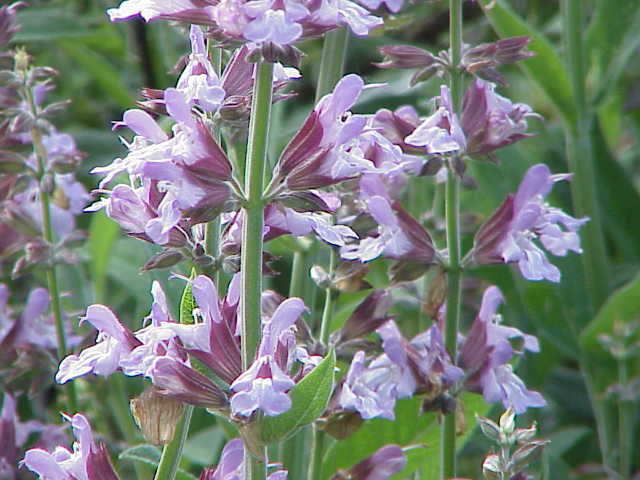 Cultivars are quite variable in size, leaf and flower color, and foliage pattern, with many variegated leaf types. The Old World type grows to approximately 2 ft (0.61 m) tall and wide, with lavender flowers most common, though they can also be white, pink, or purple. The plant flowers in late spring or summer. The leaves are oblong, ranging in size up to 2.5 in (6.4 cm) long by 1 in (2.5 cm) wide. Leaves are grey-green, rugose on the upper side, and nearly white underneath due to the many short soft hairs. Modern cultivars include leaves with purple, rose, cream, and yellow in many variegated combinations.


