In west Bengal, the rhizome of the plant is used in Kali Puja, and hence the plant is called Kali haldi. By etymology, Kali is the feminine form of Kala, which means black color and hence the plant is termed as black turmeric in English. This species has been regarded as endangered by the central forest department of India due to biopiracy.
Tuesday, September 2, 2014
Curcuma caesia
Curcuma caesia, black turmeric or black zedoary is a perennial herb with bluish-black rhizome, native to North-East and Central India. Black turmeric is also sparsely found in the Papi Hills of East Godavari, West Godavari, and the Khammam districts of Andhra Pradesh. The rhizome of black turmeric has a high economic value owing to its medicinal properties. The Black turmeic's rhizome is actually purple, compared to the orignal orange turmeric.

In west Bengal, the rhizome of the plant is used in Kali Puja, and hence the plant is called Kali haldi. By etymology, Kali is the feminine form of Kala, which means black color and hence the plant is termed as black turmeric in English. This species has been regarded as endangered by the central forest department of India due to biopiracy.
Castilla elastica
The latex gathered from Castilla elastica was converted into usable rubber by mixing the latex with the juice of the morning glory species Ipomoea alba which, conveniently, is typically found in the wild as a vine climbing Castilla elastica.
The rubber produced by this method found several uses, including most notably, the manufacture of balls for the Mesoamerican ballgame ōllamaliztli.
The Aztec (Nahuatl) word for rubber was ulli / olli, from which their word for the ballgame derived ), and also their name for the ancient people they associated with the origin of the ballgame, the Olmecs (olmeca: "rubber people"). The Nahuatl word for the tree of Castilla elastica is olicuáhuitl;in Spanish it is known as palo de hule.
Wednesday, August 27, 2014
Turmeric
Turmeric (Curcuma longa) is a rhizomatous herbaceous perennial plant of the ginger family, Zingiberaceae. It is native in southeast India, and needs temperatures between 20 °C and 30 °C (68 °F and 86 °F) and a considerable amount of annual rainfall to thrive. Plants are gathered annually for their rhizomes, and propagated from some of those rhizomes in the following season.
When not used fresh, the rhizomes are boiled for about 30–45 minutes and then dried in hot ovens, after which they are ground into a deep orange-yellow powder commonly used as a spice in Indian cuisine and even curries, for dyeing, and to impart color to mustard condiments. One active ingredient in it is curcumin. It has a distinctly earthy, slightly bitter, slightly hot peppery flavor and a mustardy smell. Curcumin may treat cancer, Alzheimer's disease, diabetes, allergies, arthritis and other chronic illnesses.
Turmeric feild

Known as haldi, turmeric has been used in India for thousands of years and is a major part of Siddha medicine. It was first used as a dye and then later for its medicinal properties.

In 1995, a U.S. patent on turmeric was awarded to the University of Mississippi Medical Center, specifically for the “use of turmeric in wound healing.” This patent also granted them the exclusive right to sell and distribute turmeric. Two years later, an Indian government organisation, The Council of Scientific and Industrial Research, filed a complaint on the grounds of piracy. They argued that this usage has been documented and been in practice for thousands of years in India. The patent was subsequently removed as it was proven to be anti-competitive.
In China, the flowering time is usually in August. Terminally on the false stem there is a 12 to 20 cm long inflorescence stem containing many flowers. The bracts are light green and ovate with a length of 3 to 5 centimeters to oblong with a blunt upper end.
At the top of the inflorescence stem bracts are present on which there are no flowers, these are, white to green and sometimes tinged reddish-purple and its upper end is tapered.
When not used fresh, the rhizomes are boiled for about 30–45 minutes and then dried in hot ovens, after which they are ground into a deep orange-yellow powder commonly used as a spice in Indian cuisine and even curries, for dyeing, and to impart color to mustard condiments. One active ingredient in it is curcumin. It has a distinctly earthy, slightly bitter, slightly hot peppery flavor and a mustardy smell. Curcumin may treat cancer, Alzheimer's disease, diabetes, allergies, arthritis and other chronic illnesses.
Turmeric feild
Known as haldi, turmeric has been used in India for thousands of years and is a major part of Siddha medicine. It was first used as a dye and then later for its medicinal properties.

In 1995, a U.S. patent on turmeric was awarded to the University of Mississippi Medical Center, specifically for the “use of turmeric in wound healing.” This patent also granted them the exclusive right to sell and distribute turmeric. Two years later, an Indian government organisation, The Council of Scientific and Industrial Research, filed a complaint on the grounds of piracy. They argued that this usage has been documented and been in practice for thousands of years in India. The patent was subsequently removed as it was proven to be anti-competitive.
In China, the flowering time is usually in August. Terminally on the false stem there is a 12 to 20 cm long inflorescence stem containing many flowers. The bracts are light green and ovate with a length of 3 to 5 centimeters to oblong with a blunt upper end.
At the top of the inflorescence stem bracts are present on which there are no flowers, these are, white to green and sometimes tinged reddish-purple and its upper end is tapered.
Tillandsia fasciculata
Tillandsia are epiphytes and need no soil because water and nutrients are absorbed through the leaves. The roots are used as anchors only. Reproduction is by seeds or by offsets called "pups". A single plant could have up to a dozen pups. Tillandsias love bright, indirect sunlight.
Indoor arrangement of six Tillandsia plants mounted on a log section.
Although not normally cultivated for their flowers, some Tillandsia will bloom on a regular basis. In addition, it is quite common for some species to take on a different leaf colour (usually changing from green to red) when about to flower. This is an indication that the plant is monocarpic (flowers once before dying) but offsets around the flowering plant will continue to thrive.
Wild Tillandsia fasciculata
Arum maculatum
Arum maculatum is a common woodland plant species of the Araceae family. It is widespread across most of Europe as well as Turkey and Caucasus. It is known by an abundance of common names including snakeshead, adder's root, arum, wild arum, arum lily, lords-and-ladies, devils and angels, cows and bulls, cuckoo-pint, Adam and Eve, bobbins, naked boys, starch-root, wake robin, friar's cowl and jack in the pulpit. The name "lords-and-ladies" and other gender related names refer to the plant's likeness to male and female genitalia symbolising copulation.

Description
The purple spotted leaves of Arum maculatum appear in the spring (April–May) followed by the flowers borne on a poker shaped inflorescence called a spadix. The purple spadix is partially enclosed in a pale green spathe or leaf-like hood. The flowers are hidden from sight, clustered at the base of the spadix with a ring of female flowers at the bottom and a ring of male flowers above them.
Above the male flowers is a ring of hairs forming an insect trap. Insects, especially owl-midges Psychoda phalaenoides, are attracted to the spadix by its faecal odour and a temperature up to 15 degrees celsius warmer than the ambient temperature. The insects are trapped beneath the ring of hairs and are dusted with pollen by the male flowers before escaping and carrying the pollen to the spadices of other plants, where they pollinate the female flowers. The spadix may also be yellow, but purple is the more common.

Description
The purple spotted leaves of Arum maculatum appear in the spring (April–May) followed by the flowers borne on a poker shaped inflorescence called a spadix. The purple spadix is partially enclosed in a pale green spathe or leaf-like hood. The flowers are hidden from sight, clustered at the base of the spadix with a ring of female flowers at the bottom and a ring of male flowers above them.
Above the male flowers is a ring of hairs forming an insect trap. Insects, especially owl-midges Psychoda phalaenoides, are attracted to the spadix by its faecal odour and a temperature up to 15 degrees celsius warmer than the ambient temperature. The insects are trapped beneath the ring of hairs and are dusted with pollen by the male flowers before escaping and carrying the pollen to the spadices of other plants, where they pollinate the female flowers. The spadix may also be yellow, but purple is the more common.
Wednesday, August 20, 2014
Gentiana cruciata
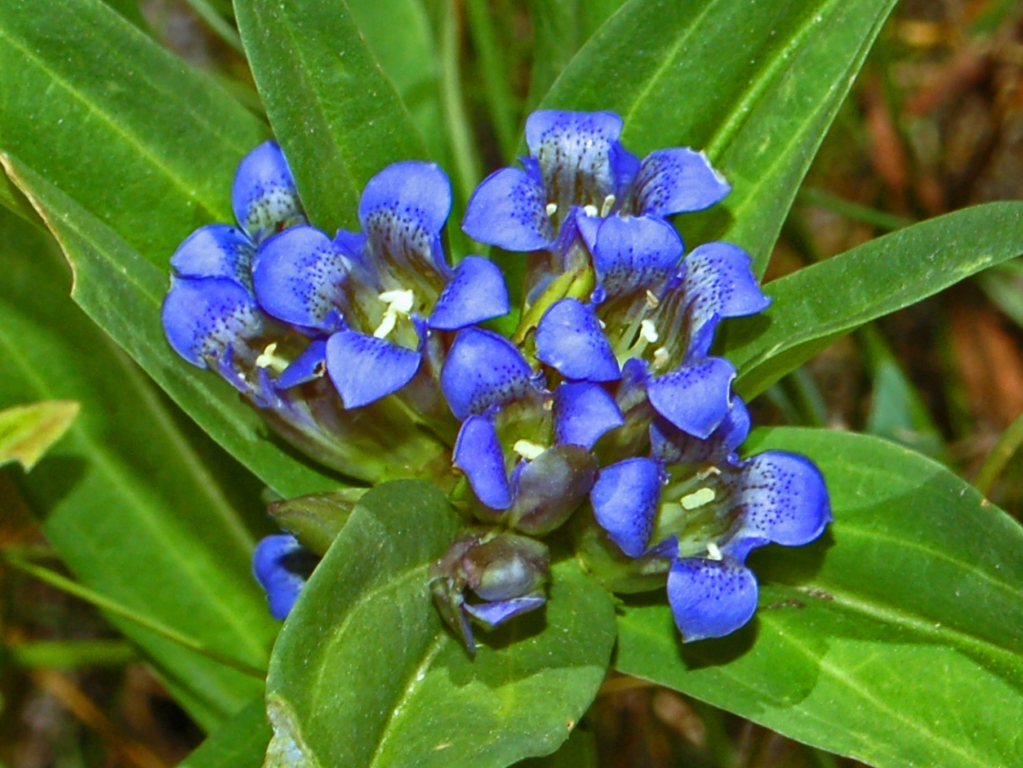
Gentiana cruciata, common name Star Gentian or Cross Gentian, is a herbaceous perennial flowering plant in the Gentianaceae family.
Gentiana cruciata is a hemicryptophyte scapose plant of small size, reaching on average 20–40 centimetres (7.9–15.7 in) in height. It has erect stems, the leaves are large, ovate-lanceolate, semiamplexicaul, about 3–8 centimetres (1.2–3.1 in) long. The flowers are violet-blue trumpets with 4 petals, clustered in the axils of upper leaves. The flowering period extends from June to August. The flowers are hermaphrodite and pollinated by insects (entomogamy). The fruit is a capsule. The seeds are dispersed by gravity alone (barochory).
Gentiana cruciata is widespread in most of Europe (except Portugal, Great Britain and Scandinavia) and in Western Asia.
Gentiana cruciata is a hemicryptophyte scapose plant of small size, reaching on average 20–40 centimetres (7.9–15.7 in) in height. It has erect stems, the leaves are large, ovate-lanceolate, semiamplexicaul, about 3–8 centimetres (1.2–3.1 in) long. The flowers are violet-blue trumpets with 4 petals, clustered in the axils of upper leaves. The flowering period extends from June to August. The flowers are hermaphrodite and pollinated by insects (entomogamy). The fruit is a capsule. The seeds are dispersed by gravity alone (barochory).
Gentiana cruciata is widespread in most of Europe (except Portugal, Great Britain and Scandinavia) and in Western Asia.
Ipomoea carnea
Ipomoea carnea, the pink morning glory, is a species of morning glory. This flowering plant has heart-shaped leaves that are a rich green and 6–9 inches long. It can be easily grown from seeds which are toxic and it can be hazardous to cattle; the toxicity is related to the bioaccumulation of selenium species in leaves but mostly in seeds.

The stem of I. carnea can be used for making paper. The plant is also of medicinal value. It contains a component identical to marsilin, a sedative and anticonvulsant. A glycosidic saponin has also been purified from I. carnea with anticarcinogenic and oxytoxic properties.
Another common name is "bush morning glory", but particularly in temperate North America, that usually refers to I. leptophylla.
In Brazil, I. carnea is known as canudo-de-pita, literally "pipe-cane", as its hollow stems were used to make tubes for tobacco pipes. It thus became the namesake of Canudos, a religious community in the sertão of Bahia, over which the War of Canudos was fought 1893–1897.
The stem of I. carnea can be used for making paper. The plant is also of medicinal value. It contains a component identical to marsilin, a sedative and anticonvulsant. A glycosidic saponin has also been purified from I. carnea with anticarcinogenic and oxytoxic properties.
Another common name is "bush morning glory", but particularly in temperate North America, that usually refers to I. leptophylla.
In Brazil, I. carnea is known as canudo-de-pita, literally "pipe-cane", as its hollow stems were used to make tubes for tobacco pipes. It thus became the namesake of Canudos, a religious community in the sertão of Bahia, over which the War of Canudos was fought 1893–1897.
Wednesday, August 13, 2014
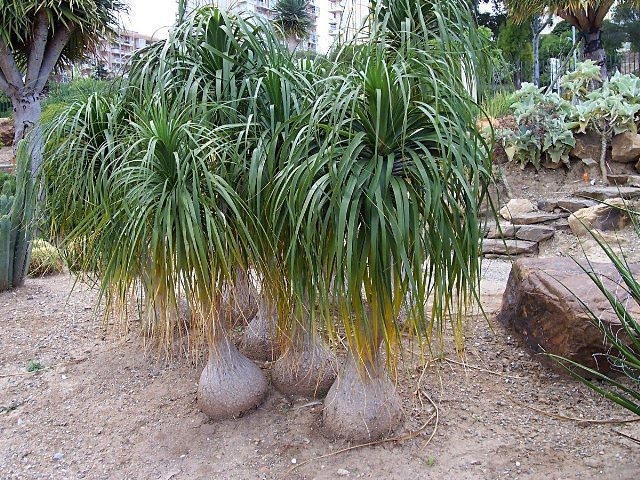
Beaucarnea recurvata
It is an evergreen perennial growing to 15 feet 6 inches (4.72 m) with a noticeable expanded caudex, for the purpose of storing water inside. The single palm-like stem produces terminal tufts of strap-shaped, recurved leathery leaves, sometimes hair lock-shaped in the ends, and with occasional panicles of small white flowers once the plant reaches over 10 years of age.
There are 10 different species of this plant, according to the Institute of Ecology in Xalapa, state of Veracruz, which runs the Jardín Botánico Francisco Javier Clavijero botanical garden, where over 400 Beaucarneas are exhibited and more are grown in greenhouses for conservation purposes, in the "Colección Nacional de Beaucarneas" (Beaucarneas National Collection).
Growing Conditions:
Light: Bright light. Ponytail palms can be acclimated to full sun.
Water: During the growing season, water every 7 to 14 days. The bulbous stems store water, so be careful not to overwater. During the winter season, cut back water to monthly.
Temperature: They prefer warm, arid temperatures, above 60ºF. However, they will survive down to 50º, providing they are not exposed to prolonged cold.
Soil: Rich, organic, fast-draining potting soil.
Fertilizer: Feed weekly with liquid fertilizer during the growing season, or use a slow-release pellet fertilizer in the spring. Reduce feeding during the winter.
B. recurvata is often grown as a houseplant or outdoor plant in temperate climate gardens. It is hardy to −5 °C (23 °F), and grows in full sun to light shade. It needs a proper soil mix to drain when watered, and must never be over-watered or mudded, as this will foster pests like the mealybug and cochineal insect. It cannot resist cold temperatures so it must be an indoor plant in countries with strong winters. When repotted it must keep all its roots. To maintain its original shape, the ends of its leaves should not be snipped. It is very slow-growing and drought-tolerant. It has gained the Royal Horticultural Society's Award of Garden Merit.
Roystonea regia
Roystonea regia, commonly known as the Cuban royal palm, Florida royal palm, or simply the royal palm is a species of palm which is native to southern Florida, Mexico and parts of Central America and the Caribbean. It ranged into central Florida in the eighteenth century but in modern times it is only known from tropical parts of south Florida. A large and attractive palm, it has been planted throughout the tropics and subtropics as an ornamental tree.Although it is sometimes called R. elata, the conserved name R. regia is now the correct name for the species. Populations in Cuba and Florida were long seen as separate species, but are now considered to belong to a single species.
Best known as an ornamental, R. regia is also used as a source of thatch, construction timber, and as a medicinal plant. The fruit is eaten by birds and bats (which disperse the seeds) and fed to livestock. Its flowers are visited by birds and bats, and it serves as a roosting site and food source for a variety of animals. Roystonea regia is the national tree of Cuba, and has a religious role both in Santería and Christianity, where it is used in Palm Sunday observances.
The trunk is stout, very smooth and grey-white in colour with a characteristic bulge below a distinctive green crownshaft. Trees have about 15 leaves which can be up to 4 m (13 ft) long. The flowers are white with pinkish anthers. The fruit are spheroid to ellipsoid in shape, 8.9–15 millimetres (0.35–0.59 in) long and 7–10.9 mm (0.28–0.43 in) wide. They are green when immature, turning red and eventually purplish-black as they mature.
Root nodules containing Rhizobium bacteria have been found on R. regia trees in India. The presence of rhizobia-containing root nodules is usually associated with nitrogen fixation in legumes; this was the first record of root nodules in a monocotyledonous tree.
Further evidence of nitrogen fixation was provided by the presence of nitrogenase (an enzyme used in nitrogen fixation) and leghaemoglobin, a compound which allows nitrogenase to function by reducing the oxygen concentration in the root nodule. In addition to evidence of nitrogen fixation, the nodules were also found to be producing indole acetic acid, an important plant hormone.
Allium crenulatum
Allium crenulatum, commonly know as the Olympic onion, is a species of plant native to Oregon, Washington, and British Columbia. It grows in the Cascades, the Coast Ranges, the Olympic Mountains, the Wenatchee Mountains, and the mountains on Vancouver Island. There is one report from Alabama, but this needs verification. The species grows on talus slopes and in alpine tundra at elevations of 600–2500 m.

Allium crenulatum produces ovoid bulbs up to 2 cm long, formed on rhizomes some distance from the parent bulb. Leaves are flat, up to 35 cm long, sometimes with minute teeth along the margins. Scape is flattened and winged, up to 15 cm tall. Umbel is compact, with up to 25 flowers. Flowers bell-shaped, up to 13 mm across; tepals pink with darker pink midveins; anthers yellow or purple; pollen yellow.
Wednesday, August 6, 2014
Alcea rosea
Alcea rosea (common hollyhock; syn. Althaea chinensis Wall., Althaea ficifolia Cav., Althaea rosea Cav.) is an ornamental plant in the Malvaceae family.
It was imported into Europe from southwestern China during, or possibly before, the 15th century.William Turner, a herbalist of the time, gave it the name "holyoke" from which the English name derives.
Alcea rosea is variously described as a biennial (having a two-year life cycle), as an annual, or as a short-lived perennial.It frequently self-sows, which may create a perception that the plants are perennial. The plant may flower during its first year when sown early. It will grow in a wide range of soils, and can easily reach a height of about 8 feet (2.4 m). The flowers are a range of colours from white to dark red, including pink, yellow and orange. Different colours prefer different soils.
The darker red variety seems to favour sandy soils, while the lighter colour seems to favour clay soils.The plants are easily grown from seed, and readily self-seed.
However, tender plants, whether young from seed or from old stock, may be wiped out by slugs and snails. The foliage is subject to attack from rust (Puccinia malvacearum), which may be treated with fungicides.Commercial growers have reported that some closely related species (Alcea rugosa and Alcea ficifolia) are resistant to this fungus.
This mix of singles features plants which produce huge (4-5" diameter), outward-facing, single flowers in a wide variety of colors including reds, pinks, whites, and light yellows. The flowers grow on rigid, towering spikes or spires which typically reach a height of 5-8' tall and usually do not require staking. Foliage features large, heart-shaped (3, 5 or 7 lobes), rough lower leaves which become progressively smaller toward the top of the spire. Long bloom period of June to August. Sometimes listed in nursery catalogs under Althaea.
It was imported into Europe from southwestern China during, or possibly before, the 15th century.William Turner, a herbalist of the time, gave it the name "holyoke" from which the English name derives.
The darker red variety seems to favour sandy soils, while the lighter colour seems to favour clay soils.The plants are easily grown from seed, and readily self-seed.
However, tender plants, whether young from seed or from old stock, may be wiped out by slugs and snails. The foliage is subject to attack from rust (Puccinia malvacearum), which may be treated with fungicides.Commercial growers have reported that some closely related species (Alcea rugosa and Alcea ficifolia) are resistant to this fungus.
This mix of singles features plants which produce huge (4-5" diameter), outward-facing, single flowers in a wide variety of colors including reds, pinks, whites, and light yellows. The flowers grow on rigid, towering spikes or spires which typically reach a height of 5-8' tall and usually do not require staking. Foliage features large, heart-shaped (3, 5 or 7 lobes), rough lower leaves which become progressively smaller toward the top of the spire. Long bloom period of June to August. Sometimes listed in nursery catalogs under Althaea.
Tuesday, August 5, 2014
Solanum seaforthianum
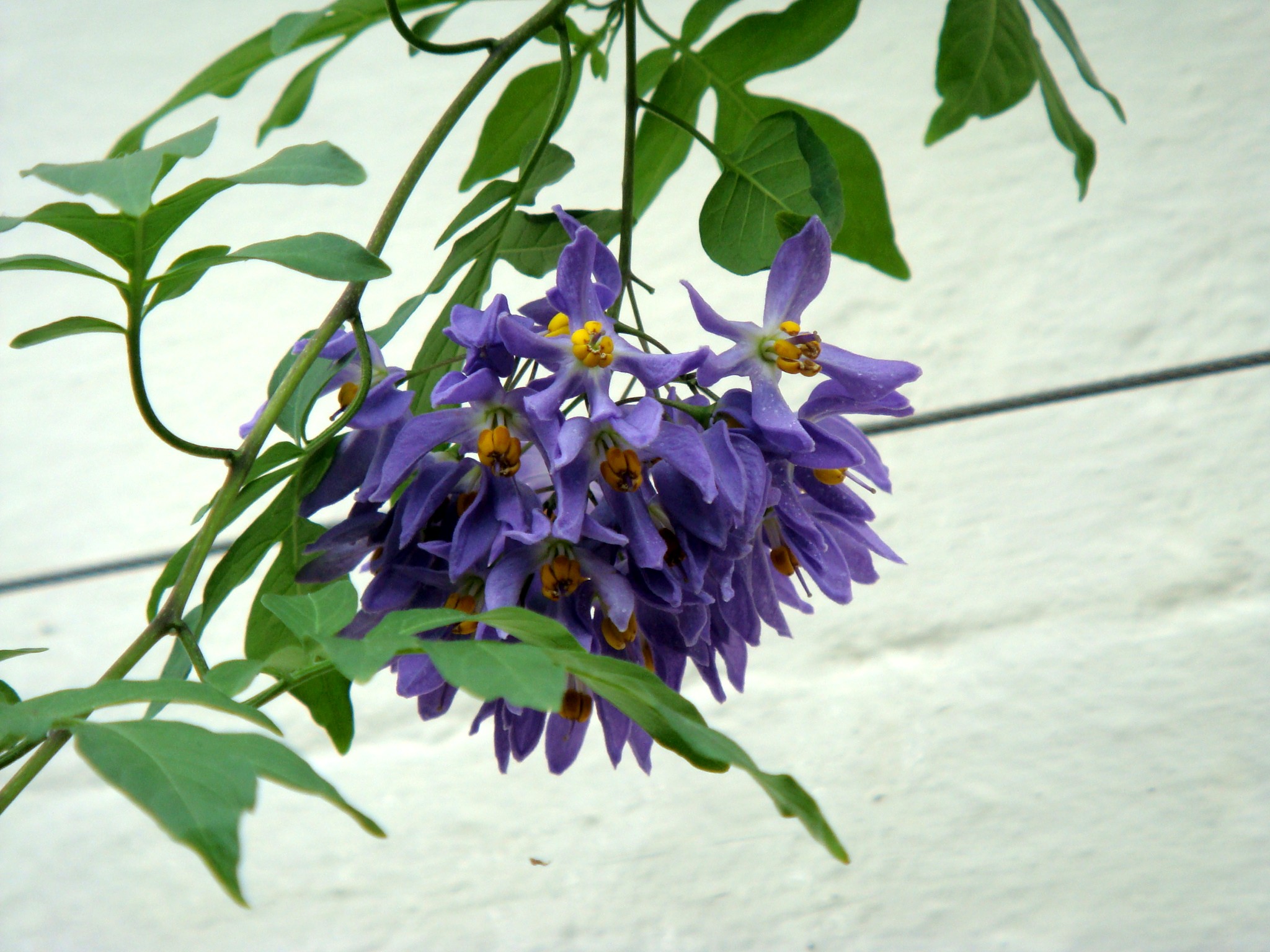
Solanum seaforthianum or Brazilian Nightshade is a flowering evergreen vine of the Solanum family native to tropical South America. As a member of the Solanum genus, it is related to such plants as the tomato and potato. It is characterized by clusters of four to seven leaves and can climb to a height of 20 ft (6 m) given enough room. It blooms in the mid to late summer with clusters of star-shaped purple inflorescence followed by scarlet marble-sized berries. The plant is highly heat resistant, but cannot tolerate frost conditions. The plant contains modest amounts of various tropane alkaloids such as atropine, scopolamine and hyoscyamine and should be considered mildly toxic and inedible.

The species has become widely naturalised outside its native range and is an invasive species in Australia, Africa, Indochina, the Pacific Islands and India, choking native vegetation and poisoning livestock.
Overtops and smothers other species. Poisonous. Indigenous birds could neglect the dispersal of indigenous plants as a consequence of their preference for the fruits of this alien species
The species has become widely naturalised outside its native range and is an invasive species in Australia, Africa, Indochina, the Pacific Islands and India, choking native vegetation and poisoning livestock.
Overtops and smothers other species. Poisonous. Indigenous birds could neglect the dispersal of indigenous plants as a consequence of their preference for the fruits of this alien species
Solanum torvum
The plant is usually 2 or 3 m in height and 2 cm in basal diameter, but may reach 5m in height and 8 cm in basal diameter. The shrub usually has a single stem at ground level, but it may branch on the lower stem. The stem bark is gray and nearly smooth with raised lenticels. The inner bark has a green layer over an ivory color (Little and others 1974). The plants examined by the author, growing on firm soil, had weak taproots and well-developed laterals. The roots are white. Foliage is confined to the growing twigs.
The twigs are gray-green and covered with starshaped hairs. The spines are short and slightly curved and vary from thick throughout the plant, including the leaf midrib, to entirely absent. The leaves are opposite or one per node, broadly ovate with the border entire or deeply lobed. The petioles are 1 to 6 cm long and the blades are 7 to 23 by 5 to 18 cm and covered with short hairs. The flowers are white, tubular with 5 pointed lobes, and grouped in corymbiform cymes. They are shed soon after opening.
The fruits are berries that grow in clusters of tiny green spheres (ca. 1 cm in diameter) that look like green peas. They become yellow when fully ripe. They are thin-fleshed and contain numerous flat, round, brown seeds (Howard 1989, Liogier 1995, Little and others 1974).
In Puerto Rico, turkey berry grows in upland sites that receive from about 1000 to 4000 mm of annual precipitation. It also grows in riparian zones in drier areas. Turkey berry grows on all types of moist, fertile soil at elevations from near sea level to almost 1,000 m in Puerto Rico (Little and others 1974) and 2,000 m in Papua New Guinea (Pacific Island Ecosystems at Risk 2001). Given an equal start after disturbance, turkey berry quickly overtops most herbs, grasses, and other shrubs. It grows best in full sunlight and does well in light shade or shade for part of the day, but cannot survive under a closed forest canopy. Turkey berry single plants, groups, and thickets are most frequently seen on roadsides, vacant lots, brushy pastures, recently abandoned farmland, landslides, and river banks.
Tuesday, July 29, 2014
Leptecophylla juniperina
Ericaceae is a family of flowering plants found most commonly in acid and infertile growing conditions. The family is large, with roughly 4000 species spread across 126 genera, making it the 14th-most-speciose family of flowering plants. The many well-known and economically important members of the Ericaceae include the cranberry, blueberry, huckleberry, azalea, rhododendron, and various common heaths and heathers (Erica, Cassiope, Daboecia, and Calluna for example).Distribution and ecology
The family is largely composed of plants that can tolerate acidic, infertile conditions. Like other stress-tolerant plants, many Ericaceae have mycorrhizal fungi to assist with extracting nutrients from infertile soils, as well as evergreen foliage to conserve absorbed nutrients. This trait is not found in the Clethraceae and Cyrillaceae, the two families most closely related to the Ericaceae. Most Ericaceae (excluding the Monotropoideae, Pyroloideae, and some Styphelioideae) form a distinctive accumulation of mycorrhizae, in which fungi grow in and around the roots and provide the plant with nutrients. The Pyroleae tribe are mixotrophic and gain sugars from the mycorrhizae, as well as nutrients.
In many parts of the world, a "heath" or "heathland" is an environment characterised by an open dwarf-shrub community found on low-quality acidic soils, generally dominated by plants in the Ericaceae. A common example is Erica tetralix. This plant family is also typical of peat bogs and blanket bogs; examples include Rhododendron groenlandicum and Kalmia polifolia. In eastern North America, members of this family often grow in association with an oak canopy, in a habitat known as an oak-heath forest.
Some evidence suggests eutrophic rainwater can convert ericoid heaths with species such as Erica tetralix to grasslands. Nitrogen is particularly suspect in this regard, and may be causing measurable changes to the distribution and abundance of some ericaceous species.
Impatiens balsamina
Genus: Impatiens

This plant has a sparsely branched form and narrow lance-shaped, pale green leaves. Cup-shaped hooded flowers 1-2 inches across, either singly or in clusters, are followed by explosive seed capsules. A variety of colors are available, including rose, lilac, and creamy yellow.
Care: Does best in partial shade and moist, well-draining loam. Add composted organic matter to the soil for optimal performance. Shelter from wind. Impatiens balsamina is free-flowering and grows well in shade.
Propagation: Sow seed in early spring.
Problems: Spider mites, flower thrips, root knot nematode, whiteflies, and aphids, especially under glass. Caterpillars outdoors. Gray mold, impatiens necrotic spot virus, fungal leaf spots, Rhizoctonia stem rot, Pseudomonas leaf spot, and Verticillium wilt.
Medicinal uses
Different parts of the plant are used as traditional remedies for disease and skin afflctions. Juice from the leaves is used to treat warts and snakebite, and the flower is applied to burns.This species has been used as indigenous traditional medicine in Asia for rheumatism, fractures, and other ailments. In Korean folk medicine this impatiens species is used as a medicine called bong seon wha dae for the treatment of constipation and gastritis. One in vitro study found extracts of this impatiens species, especially of the seed pod, to be active against antibiotic-resistant strains of Helicobacter pylori. It is also an inhibitor of 5α-reductases, enzymes that reduce testosterone levels.
This plant has a sparsely branched form and narrow lance-shaped, pale green leaves. Cup-shaped hooded flowers 1-2 inches across, either singly or in clusters, are followed by explosive seed capsules. A variety of colors are available, including rose, lilac, and creamy yellow.
Propagation: Sow seed in early spring.
Problems: Spider mites, flower thrips, root knot nematode, whiteflies, and aphids, especially under glass. Caterpillars outdoors. Gray mold, impatiens necrotic spot virus, fungal leaf spots, Rhizoctonia stem rot, Pseudomonas leaf spot, and Verticillium wilt.
Medicinal uses
Different parts of the plant are used as traditional remedies for disease and skin afflctions. Juice from the leaves is used to treat warts and snakebite, and the flower is applied to burns.This species has been used as indigenous traditional medicine in Asia for rheumatism, fractures, and other ailments. In Korean folk medicine this impatiens species is used as a medicine called bong seon wha dae for the treatment of constipation and gastritis. One in vitro study found extracts of this impatiens species, especially of the seed pod, to be active against antibiotic-resistant strains of Helicobacter pylori. It is also an inhibitor of 5α-reductases, enzymes that reduce testosterone levels.
Lamium purpureum
It grows to 5–20 cm (rarely 30 cm) in height. The leaves have fine hairs, are green at the bottom and shade to purplish at the top; they are 2–4 cm long and broad, with a 1–2 cm petiole (leaf stalk), and wavy to serrated margins.
The zygomorphic flowers are bright red-purple, with a top hood-like petal, two lower lip petal lobes and minute fang-like lobes between.They may be produced throughout the year, including mild weather in winter. This allows bees to gather its nectar for food when few other nectar sources are available. It is also a prominent source of pollen for bees in March/April (in UK), when bees need the pollen as protein to build up their nest.
It is often found alongside Henbit Deadnettle (Lamium amplexicaule), which is easily mistaken for it since they both have similar looking leaves and similar bright purple flowers; they can be distinguished by the stalked leaves of Red Deadnettle on the flower stem, compared to the unstalked leaves of Henbit Deadnettle.
Leaves: Opposite (decussate), stalked, stalk wingless. Blade triangularly ovate, with cordate–flat base, net-veined, smooth-haired, evenly shallowly large-toothed. Upper leaves often reddish. Subtending bracts like stem leaves.
Fruit: 4-parted schizocarp. Mericarps slightly bristly, brown.
Habitat: Gardens, soil heaps, rubbish tips, pastures, arable land, wasteland.
Flowering time: May–October.
Tuesday, July 22, 2014
Dracunculus vulgaris
Common Name: dragon arum
Type: Herbaceous perennial
Family: Araceae
Native Range: Central and eastern Mediterranean
Zone: 7 to 10
Height: 2.00 to 3.00 feet
Spread: 1.00 to 2.00 feet
Bloom Time: June to July
Bloom Description: Maroon purple
Sun: Full sun to part shade
Water: Medium
Maintenance: Low
Flower: Showy, Fragrant
Fruit: Showy
Growing Requirements:
Easily grown in average, medium moisture, well-drained soils in full sun to part shade. Prefers moist, rich soils. Spreads by self-seeding and bulb offsets. Plants are not reliably winter hardy throughout the St. Louis area where mulch should be applied in winter to help protect them from cold temperatures. In cold winter areas north of USDA Zone 6, tubers may be dug up in autumn, overwintered indoors and replanted in spring in somewhat the same manner as dahlias.
Noteworthy Characteristics
Dragon arum is closely related to the Titan arum, which describes why Dragon arum also has the simalar leaves and flowers to it's larger cousin.
Dragon arum is a tuberous herbaceous perennial that is native to rocky areas and hillsides in the central to eastern Mediterranean areas from Greece to the Balkans to Turkey. It typically grows to 3' tall and features large, erect, fan-shaped, palmately-divided, dark green leaves (to 12" long) that are often streaked with white. Each leaf has 9-15 finger-like lobes reportedly resembling in appearance the claw of a dragon, hence the common name.

Leaves appear in clusters on a stalk-like, black/purple-spotted pseudostem. Large, foul-smelling, maroon-purple spathes (each to as much as 20" long and 8" wide) appear above the leaves in late spring/early summer. The foul odor of the spathes, sometimes described as akin to the nauseous aroma of rotten meat, attracts flies for pollinating the flowers. Each spathe envelops a central, upright, nearly black, tail-like spike (spadix) which is nearly as long as the spathe, but sometimes longer, with a diameter of only 1/2 to 3/4". The spathe contains inconspicuous, hidden, unisexual flowers. Flowers are followed by green berries which mature to orange-red in fall. This plant is synonymous with and formerly called Arum dracunculus.
Type: Herbaceous perennial
Family: Araceae
Native Range: Central and eastern Mediterranean
Zone: 7 to 10
Height: 2.00 to 3.00 feet
Spread: 1.00 to 2.00 feet
Bloom Time: June to July
Bloom Description: Maroon purple
Sun: Full sun to part shade
Water: Medium
Maintenance: Low
Flower: Showy, Fragrant
Fruit: Showy
Growing Requirements:
Easily grown in average, medium moisture, well-drained soils in full sun to part shade. Prefers moist, rich soils. Spreads by self-seeding and bulb offsets. Plants are not reliably winter hardy throughout the St. Louis area where mulch should be applied in winter to help protect them from cold temperatures. In cold winter areas north of USDA Zone 6, tubers may be dug up in autumn, overwintered indoors and replanted in spring in somewhat the same manner as dahlias.
Noteworthy Characteristics
Dragon arum is closely related to the Titan arum, which describes why Dragon arum also has the simalar leaves and flowers to it's larger cousin.
Dragon arum is a tuberous herbaceous perennial that is native to rocky areas and hillsides in the central to eastern Mediterranean areas from Greece to the Balkans to Turkey. It typically grows to 3' tall and features large, erect, fan-shaped, palmately-divided, dark green leaves (to 12" long) that are often streaked with white. Each leaf has 9-15 finger-like lobes reportedly resembling in appearance the claw of a dragon, hence the common name.
Golden pothos
Epipremnum aureum is a species of flowering plant in the family Araceae, with a broad native Old World distribution. Native range extends from Northern Australia through Malaysia and Indochina into China, Japan and India.
The species has become naturalised in tropical and sub-tropical forests worldwide, where it has caused severe ecological damage in some cases (see below).

The plant has a multitude of common names including Australian native monstera, centipede tongavine, devil's ivy, golden pothos, hunter's robe, ivy arum, money plant, silver vine, Solomon Islands ivy and taro vine.
It is sometimes mistakenly labeled as a Philodendron in plant stores.
E. aureum is an evergreen vine growing to 20 m (66 ft) tall, with stems up to 4 cm (2 in) in diameter, climbing by means of aerial roots which adhere to surfaces. The leaves are alternate, heart-shaped, entire on juvenile plants, but irregularly pinnatifid on mature plants, up to 100 cm (39 in) long and 45 cm (18 in) broad (juvenile leaves much smaller, typically under 20 cm (8 in) long). The flowers are produced in a spathe up to 23 cm (9 in) long.
This plant produces trailing air roots when it climbs up trees, and leaves on these trailing stems grow up to 40+cm wide.
In temperate regions it is a popular houseplant with numerous cultivars selected for leaves with white, yellow, or light green variegation. It is often used in decorative displays in shopping centers, offices, and other public locations largely because it requires little care and is also attractively leafy. It is also efficient at removing indoor pollutants such as formaldehyde, xylene, and benzene. A study found that this effect lessened the higher the molecular weight of the polluting substance.

As a houseplant it can reach a height of 2 m (6 ft 7 in) or more, given suitable support. It has gained the Royal Horticultural Society's Award of Garden Merit.
The plant is sometimes used in aquariums, placed on top of the aquarium and allowed to grow roots in the water. This is beneficial to the plant and the aquarium as it absorbs many nitrates and uses them for growth.
The species has become naturalised in tropical and sub-tropical forests worldwide, where it has caused severe ecological damage in some cases (see below).
The plant has a multitude of common names including Australian native monstera, centipede tongavine, devil's ivy, golden pothos, hunter's robe, ivy arum, money plant, silver vine, Solomon Islands ivy and taro vine.
It is sometimes mistakenly labeled as a Philodendron in plant stores.
E. aureum is an evergreen vine growing to 20 m (66 ft) tall, with stems up to 4 cm (2 in) in diameter, climbing by means of aerial roots which adhere to surfaces. The leaves are alternate, heart-shaped, entire on juvenile plants, but irregularly pinnatifid on mature plants, up to 100 cm (39 in) long and 45 cm (18 in) broad (juvenile leaves much smaller, typically under 20 cm (8 in) long). The flowers are produced in a spathe up to 23 cm (9 in) long.
This plant produces trailing air roots when it climbs up trees, and leaves on these trailing stems grow up to 40+cm wide.
In temperate regions it is a popular houseplant with numerous cultivars selected for leaves with white, yellow, or light green variegation. It is often used in decorative displays in shopping centers, offices, and other public locations largely because it requires little care and is also attractively leafy. It is also efficient at removing indoor pollutants such as formaldehyde, xylene, and benzene. A study found that this effect lessened the higher the molecular weight of the polluting substance.
As a houseplant it can reach a height of 2 m (6 ft 7 in) or more, given suitable support. It has gained the Royal Horticultural Society's Award of Garden Merit.
The plant is sometimes used in aquariums, placed on top of the aquarium and allowed to grow roots in the water. This is beneficial to the plant and the aquarium as it absorbs many nitrates and uses them for growth.
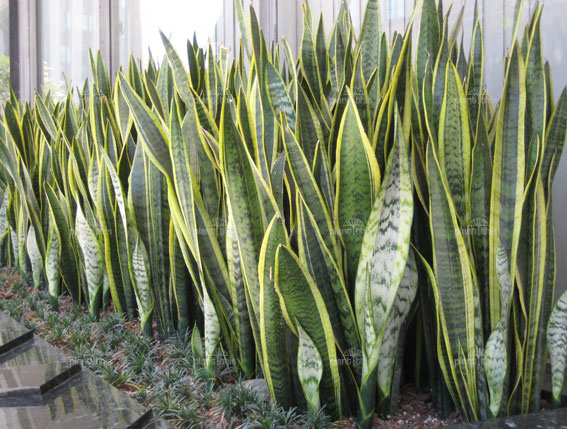
Sansevieria trifasciata
It is a common ornamental plant, for a few very good reasons.
Like all easy houseplants, it thrives on neglect. Low light and infrequent, irregular, waterings serve this plant well, which is great for those who want the tropical look, without the bright light and humidity to support it.
Most people, especially plant people, are familiar with the important role that plants (and other photosynthetic organisms) play in our lives by taking in carbon dioxide from the air and producing oxygen. Air quality is about more than just carbon dioxide and oxygen levels though, but thankfully plants play an important role in helping us with air pollution too.
Sansevieria has many varieties, each of them will give an exotic look to any garden. All of these varieties can be grown the same way.
Growing conditions:
The following is also apllied to closely related species, and basically the whole Sansevieria family.
Light: Grows indoors well, and grows best in places with 2~4 hours of direct sunlight. If your windowsill is bright throughout the day, direct sunlight isn't required.
Leaves turn light yellow, and green becomes grey-green when it is grown under hot, dry sunny condtions so that is not recommended.
Water: Let the soil dry between waterings. During winter, reduce watering to monthly, or whenever the soil is dry to the touch. In the tropics, this plant should be watered every 2 days.
Temperature: They prefer warmth and will suffer if exposed to temperatures below 50ºF.
Soil: A loose, well-drained potting mix. They will do well in a variety of soils, so just make sure if you water, the water drains out of the soil.
Fertilizer: Feed a mild cactus fertilizer during the growing season; do not fertilizer in the winter. If you grow it in a tropical area, it can be fertilized year round, and ordinary nitrogen-rich organic fertilizer can work wonders on the plant.
Propagation:
Sansevieria can be divided easily during repotting. Alternatively, new shoots, which emerge from the soil as spikes, can be taken and potted independently. They are rapid growers once established. Mature leaves can also be used to clone a new plant, which can be done by placing the base of a mature leave on a bowl of water.
After 2 months, the base of the leave should have devolped roots, and after 3 months there should be a little plant poping out of the area where it used to connect with that mother plant.
Grower's Tips:
These are one of the best houseplants for beginners and for striking displays. They are excellent in a grouping and will grow equally do well on the floor or on table-top displays. Native to tropical Africa, the biggest danger is overwatering, and over exposure to strong sunlight. There are many growing varieties, but these are rarely seen in garden centers, depending which country you are on.
-I have 7 years of growing experience on Sansevierias, and I've found alot of things about Sansevierias to be false on the internet.
Tuesday, July 15, 2014
Leuchtenbergia principis
Leuchtenbergia principis (agave cactus or prism cactus), the sole species of the genus Leuchtenbergia, is a species of cactus. It is native to north-central Mexico (San Luis Potosi, Chihuahua). The genus is named after Maximilian Eugen Joseph (1817–1852), Duke of Leuchtenberg and amateur botanist.
It is very slow-growing but can eventually grow up to 70 cm high, with a cylindrical stem which becomes bare and corky at the base with age. It has long, slender, grayish-green tubercles 6–12 cm long, with purplish-red blotches at their tips. The tubercles are topped with papery spines, making the plant resemble an agave; old, basal tubercles dry up and fall off. After four years or so, yellow, funnel-shaped flowers 5–6 cm diameter may be borne at the tubercle tips. The fruit is smooth and green, 3 cm long and 2 cm broad. It has a large, tuberous taproot.
Because they're adapted to grow in the shade of other plants, Leuchtenbergia is perfectly able to survive without a lot of direct sun. The tubercles can move around a bit, depending on the light and humidity: they'll lie flat if there's too little light, and pull closer together and more upright if the air is exceptionally dry. So if you notice that your plant's lying flatter than it was when you bought it, well, that's one possible reason why.
Subscribe to:
Posts (Atom)