Tridax procumbens, commonly known as coatbuttons or tridax daisy, is a species of flowering plant in the daisy family. It is best known as a widespread weed and pest plant. It is native to the tropical Americas but it has been introduced to tropical, subtropical, and mild temperate regions worldwide. It is listed as a noxious weed in the United States and has pest status in nine states.
 The plant bears daisylike yellow-centered white or yellow flowers with three-toothed ray florets. The leaves are toothed and generally arrowhead-shaped. Its fruit is a hard achene covered with stiff hairs and having a feathery, plumelike white pappus at one end. Calyx is represented by scales or reduced to pappus. The plant is invasive in part because it produces so many of these achenes, up to 1500 per plant, and each achene can catch the wind in its pappus and be carried some distance. This weed can be found in fields, meadows, croplands, disturbed areas, lawns, and roadsides in areas with tropical or semi-tropical climates.
 Centaurea cyanus, commonly known as cornflower, is an annual flowering plant in the family Asteraceae, native to Europe. In the past it often grew as a weed in cornfields (in the broad sense of the word "corn", referring to grains, such as wheat, barley, rye, or oats), hence its name. It is now endangered in its native habitat by agricultural intensification, particularly over-use of herbicides, destroying its habitat; in the United Kingdom it has declined from 264 sites to just 3 sites in the last 50 years. In reaction to this, the conservation charity Plantlife named it as one of 101 species it would actively work to bring 'Back from the Brink'.
 It is also, however, through introduction as an ornamental plant in gardens and a seed contaminant in crop seeds, now naturalised in many other parts of the world, including North America and parts of Australia.
 Cornflower is an annual plant growing to 16-35 inches tall, with grey-green branched stems. The leaves are lanceolate, 1–4 cm long. The flowers are most commonly an intense blue colour, produced in flowerheads (capitula) 1.5–3 cm diameter, with a ring of a few large, spreading ray florets surrounding a central cluster of disc florets. The blue pigment is protocyanin, which in roses is red. It flowers all summer.
It is grown as an ornamental plant in gardens, where several cultivars have been selected with varying pastel colours, including pink and purple. Cornflower is also grown for the cutflower industry in Canada for use by florists. The most common colour variety for this use is a doubled blue variety such as 'Blue Boy' or 'Blue Diadem'. White, pink, lavender and black (actually a very dark maroon) are also used but less commonly. A relative, Centaurea montana, is a perennial plant which is also cultivated as a garden plant. Cornflowers germinate quickly after planting.
Light requirements: full sun. Water requirements: high-average water daily. Soil pH requirements: neutral (6.6-7.5) to mildly alkaline (7.6-7.8).
 Cucumis anguria, commonly known as cackrey, maroon cucumber, West Indian gherkin, and West Indian gourd, is a vine that is indigenous to Africa, but has become naturalized in the New World, and is cultivated in many places. It is similar and related to the common cucumber (C. sativus) and its cultivars are known as gherkins.
Cucumis anguria is a thinly stemmed, herbaceous vine scrambling up to 3 meters long. Fruits (4–5 cm × 3–4 cm) are longly stalked, and ovoid to oblong. The surface of the fruits have long hairs covering a surface having warts or spines: The inner flesh is palid to green.
 Cucumis anguria is primarily grown (as a crop plant) for its edible fruit, which are used in pickling, as cooked vegetables, or eaten raw. The flavor is similar to that of the common cucumber. C. anguria fruits are popular in the northeast and north of Brazil, where they are an ingredient in the local version of cozido (meat-and-vegetable stew).
Cucumis anguria has been used in folk medicine to treat ailments of the stomach.
Cucumis anguria is primarily grown (as a crop plant) for its edible fruit, which are used in pickling, as cooked vegetables, or eaten raw. The flavor is similar to that of the common cucumber. C. anguria fruits are popular in the northeast and north of Brazil, where they are an ingredient in the local version of cozido (meat-and-vegetable stew).
Cucumis anguria has been used in folk medicine to treat ailments of the stomach.
Crops are susceptible to attacks by fungi, aphids, and cucumber beetles.
 Calochortus nuttallii, with the common name sego lily, is a bulbous perennial which is endemic to the Western United States.
Calochortus nuttallii is cultivated as an ornamental plant for its attractive tulip-shaped flowers and to attract/support native pollinator species. It prefers a deep, sandy soil with good drainage, and is cold-hardy. Plants can be propagated from newly formed bulblets which take two years to flower.
It is the state flower of Utah.
Calochortus nuttallii, with the common name sego lily, is a bulbous perennial which is endemic to the Western United States.
Calochortus nuttallii is cultivated as an ornamental plant for its attractive tulip-shaped flowers and to attract/support native pollinator species. It prefers a deep, sandy soil with good drainage, and is cold-hardy. Plants can be propagated from newly formed bulblets which take two years to flower.
It is the state flower of Utah.
 The plant is native to a number of western states including Idaho, Montana, Wyoming, North Dakota, South Dakota, Nebraska, Nevada, Utah, Colorado, Arizona, and New Mexico.
Calochortus nuttallii are around 15–45 cm (6–18 inches) in height and have linear leaves.
Plants have 1 to 4 flowers, each with 3 white petals (and 3 sepals) which are tinged with lilac (occasionally magenta) and have a purplish band radiating from the yellow base. A yellow petaled form with deep purple bands is known from Petrified Forest National Park. The plant blooms in early summer, with flowers that can be up to 3 inches across.
Calochortus nuttallii is a species within the genus Calochortus, in a sub-group generally referred to as Mariposa Lilies. The specific epithet nuttallii, named for the English botanist and zoologist, Thomas Nuttall, was ascribed to the species by the American botanists John Torrey and Asa Gray when it was officially described in 1857.
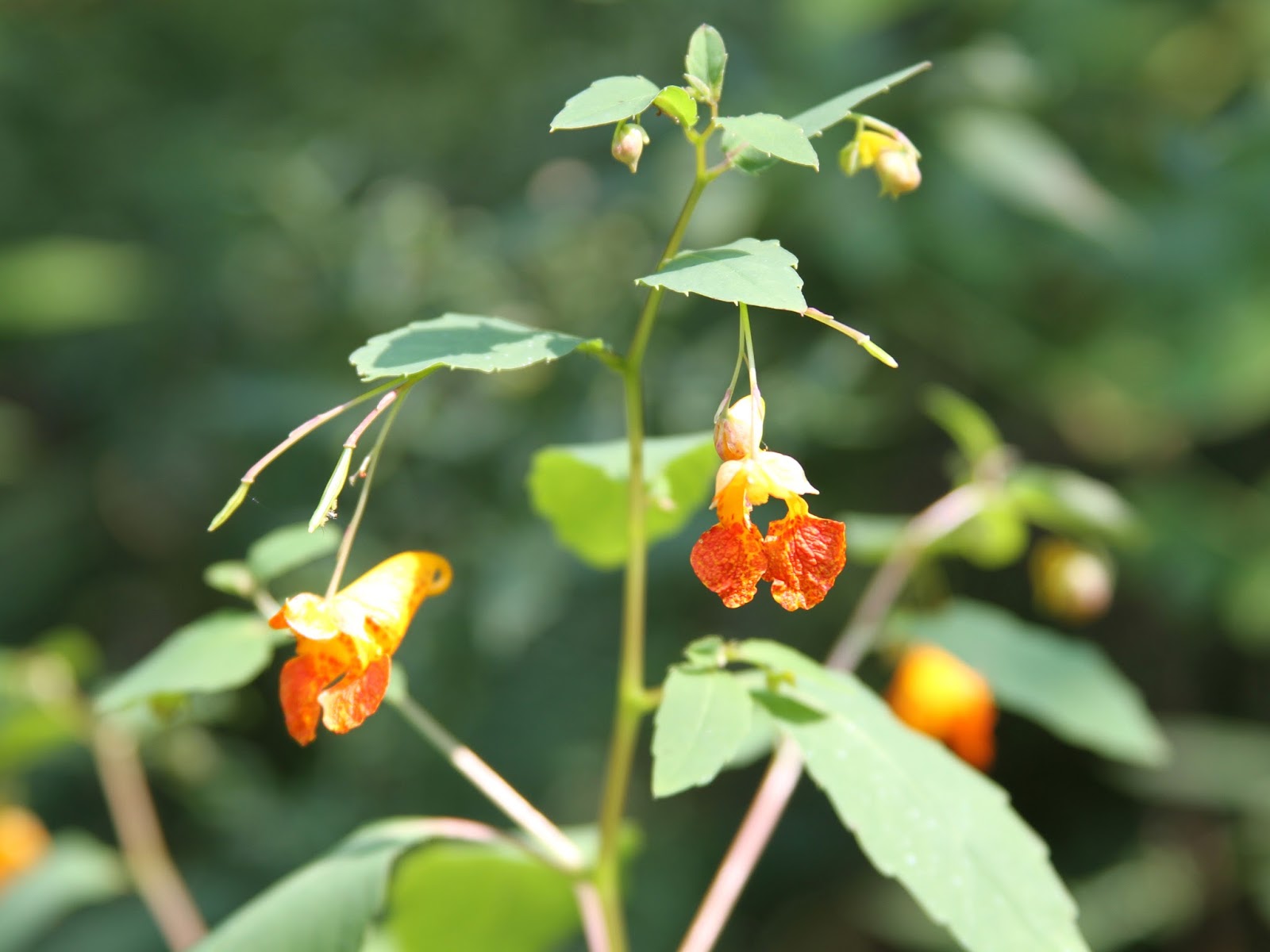
Impatiens capensis, the orange jewelweed, common jewelweed, spotted jewelweed, spotted touch-me-not, or orange balsam, is an annual plant native to North America. It is common in bottomland soils, ditches, and along creeks, often growing side-by-side with its less common relative, Yellow Jewelweed (I. pallida).
Jewelweed plants grow 3 to 5 feet tall and bloom from late spring to early fall. The flowers are orange (or rarely yellow) with a three-lobed corolla; one of the calyx lobes is colored similarly to the corolla and forms a hooked conical spur at the back of the flower. Plants may also produce non-showy cleistogamous flowers, which do not require cross-pollination. The stems are somewhat translucent, succulent, and have swollen or darkened nodes (on only some plants).
The seed pods are pendant and have projectile seeds that explode out of the pods when they are lightly touched, if ripe, which is where the name 'touch-me-not' comes from. The leaves appear to be silver or 'jeweled' when held underwater, which is possibly where the jewelweed name comes from.
Along with other species of jewelweed the juice of the leaves and stems is a traditional Native American remedy for skin rashes, including poison ivy and such use has been supported by at least one peer-reviewed study.
The species name "capensis", meaning "of the cape", is actually a misnomer, as Nicolaas Meerburgh was under the mistaken impression that it was native to the Cape of Good Hope, in southern Africa.
Impatiens capensis was transported in the 19th and 20th centuries to England, France, the Netherlands, Poland, Sweden, Finland, and potentially other areas of northern and central Europe. These naturalized populations persist in the absence of any common cultivation by people.
This jewelweed species is quite similar to Impatiens noli-tangere, an Impatiens species native to Europe and Asia, as well as the other North American Impatiens. No evidence exists of natural hybrids, although the habitats occupied by the two species are very similar.
Pollination
 Nectar spurs are tubular elongations of petals and sepals of certain flowers that usually contain nectar. Flowers of Impatiens capensis have these nectar spurs. Nectar spurs are thought to have played a role in plant-pollinator coevolution. Curvature angles of nectar spurs of Impatiens capensis are variable. This angle varies from 0 degrees to 270 degrees.
The angle of the nectar spur is very important in the pollination of the flower and in determining the most efficient pollinator. Hummingbirds are the main pollinators. They remove more pollen per visit from flowers with curved nectar spurs than with perpendicular nectar spurs. But hummingbirds are not the only pollinators of Impatiens capensis. Bees play an important role in pollination as well. Due to hummingbirds and bees, the pollination of Impatiens capensis is very high
 Rubus arcticus, the Arctic bramble or Arctic raspberry, (includes Rubus arcticus ssp. acaulis - (Michx.) is a species of slow-growing bramble belonging to the rose family, found in arctic and alpine regions in the Northern Hemisphere. Its dark red fruit is considered a delicacy.
 In the Pacific Northwest of western Canada and the northwestern United States, it is sometimes called the nagoon or nagoonberry, a name which derives from the Tlingit neigóon. A measure of the quality of its fruit is expressed in its Russian name княженика knyazhenika, signifying the "berry of princes". It grows in Alaska, northern Scandinavia, Russia, Poland, Belarus, Mongolia, northeastern China, North Korea , Estonia, Lithuania, Canada, and the northern United States as far south as Oregon, Colorado, Michigan, and Maine.
 Rubus arcticus grows most often in acidic soils rich in organic matter. It is a thornless perennial up to 30 cm (1 foot) tall, woody at the base but very thin farther above the ground. flowers are in groups of 1-3, the petals pink, red, or magenta. Fruit is deep red or dark purple, with an unusual hardiness to frost and cold weather conditions.
Protea cynaroides, the king protea, is a flowering plant. It is a distinctive member of Protea, having the largest flower head in the genus. The species is also known as giant protea, honeypot or king sugar bush. It is widely distributed in the southwestern and southern parts of South Africa in the fynbos region.
The king protea is the national flower of South Africa. It also is the flagship of the The Protea Atlas Project, run by the South African National Botanical Institute.
The king protea has several colour forms and horticulturists have recognized 81 garden varieties, some of which have injudiciously been planted in its natural range. In some varieties the pink of the flower and red borders of leaves are replaced by a creamy yellow. This unusual flower has a long vase life in flower arrangements, and makes for an excellent dried flower.
Protea cynaroides is adapted to survive wildfires by its thick underground stem, which contains many dormant buds; these will produce the new growth after the fire.
The name of the plant family Proteaceae as well as the genus Protea, both to which P. cynaroides belongs to, derive from the name of the Greek god Proteus, a deity that was able to change between many forms. This is an appropriate image, seeing as both the family and the genus are known for their astonishing variety and diversity of flowers and leaves.

The specific epithet cynaroides refers to the artichoke-like appearance of the flower-heads: the artichoke belongs to the genus Cynara.
P. cynaroides is a woody shrub with thick stems and large dark green, glossy leaves. Most plants are one metre in height when mature, but may vary according to locality and habitat from 0.35 m to 2 metres in height. The "flowers" of Protea cynaroides are actually composite flower heads (termed an inflorescence) with a collection of flowers in the centre, surrounded by large colourful bracts.
The flowerheads vary in size, from about 120 mm to 300 mm in diameter. Large, vigorous plants produce six to ten flower heads in one season, although some exceptional plants can produce up to forty flower heads on one plant. The colour of the bracts varies from a creamy white to a deep crimson, but the soft pale pink bracts with a silvery sheen are the most prized.
P. cynaroides grows in a harsh environment with dry, hot summers and wet, cold winters. Several adaptions include tough, leathery leaves, which helps to prevent excessive loss of moisture, and a large taproot which penetrates deep into the soil to reach underground moisture. Like most other Proteaceae, P. cynaroides has proteoid roots, roots with dense clusters of short lateral rootlets that form a mat in the soil just below the leaf litter. These enhance solubilisation of nutrients, thus allowing nutrient uptake in the low-nutrient, phosphorus-deficient soils of its native fynbos habitat.
The flowers are fed at by a range of nectarivorous birds, mainly sunbirds and sugarbirds, including the orange-breasted sunbird (Anthobaphes violacea), southern double-collared sunbird (Cinnyris chalybeus), malachite sunbird (Nectarinia famosa), and the Cape sugarbird (Promerops cafer). In order to reach the nectar, the bird must push its bill into the inflorescence. As it does so, its bill and face gets brushed with pollen, thereby allowing for possible pollination.
Along with birds, a host of insects are attracted to the flowerhead, such as bees, for example the Cape honeybee, and various beetle species such as rove beetles and the beetles of the huge family Scarabaeidae such as the protea beetle Trichostetha fascicularis and monkey beetles.
Like many other Protea species, P. cynaroides is adapted to an environment in which bushfires are essential for reproduction and regeneration. Most Protea species can be placed in one of two broad groups according to their response to fire: reseeders are killed by fire, but fire also triggers the release of their canopy seed bank, thus promoting recruitment of the next generation; resprouters survive fire, resprouting from a lignotuber or, more rarely, epicormic buds protected by thick bark. P. cynaroides is a resprouter as it shoots up new stems from buds in its thick underground stem after a fire.
 Lilium bulbiferum, common names orange lily, fire lily and tiger lily, is a herbaceous European lily with underground bulbs, belonging to the Liliaceae. The Latin name bulbiferum of this species, meaning "bearing bulbs", refers to the secondary bulbs on the stem of the nominal subspecies.
Lilium bulbiferum reaches on average 20–90 centimetres (7.9–35.4 in) of height, with a maximum of 120 centimetres (47 in). The bulbs are ovoid, with whitish large and pointed scales and can reach about 1.5 centimetres (0.59 in) of diameter. The stem is erect, the leaves are lanceolate, up to 10 centimeters long. The inflorescence has one to five short-haired flowers. They are hermaphroditic and scentless, have six upright tepals, the outer are slightly narrower than the inner ones. The flowers can reach 4–6 centimeters in length and are bright yellow-orange with reddish-brown dots. The stamens are erect, about half as long as the tepals, with red anthers. The style is orange, 35 millimetres (1.4 in) of height. The flowering period extends from May through July.
Lilium bulbiferum, common names orange lily, fire lily and tiger lily, is a herbaceous European lily with underground bulbs, belonging to the Liliaceae. The Latin name bulbiferum of this species, meaning "bearing bulbs", refers to the secondary bulbs on the stem of the nominal subspecies.
Lilium bulbiferum reaches on average 20–90 centimetres (7.9–35.4 in) of height, with a maximum of 120 centimetres (47 in). The bulbs are ovoid, with whitish large and pointed scales and can reach about 1.5 centimetres (0.59 in) of diameter. The stem is erect, the leaves are lanceolate, up to 10 centimeters long. The inflorescence has one to five short-haired flowers. They are hermaphroditic and scentless, have six upright tepals, the outer are slightly narrower than the inner ones. The flowers can reach 4–6 centimeters in length and are bright yellow-orange with reddish-brown dots. The stamens are erect, about half as long as the tepals, with red anthers. The style is orange, 35 millimetres (1.4 in) of height. The flowering period extends from May through July.

There are two varieties, L. b. var. croceum (Chaix) Baker in the western part of the range, and L. b. var. bulbiferum in its eastern part. Only the last one always produces secondary aerial bulbs (bulbils) in the axils of the upper leaves. These bulbils fall to the ground and mature after two to three years. When manually separated from the stem they can easily used for propagating the plant.
 The dwarf plants from the Maritime Alps, formerly described as var. chaixii (Elwes) Stoker, and the large plants from the region of Naples, formerly described as var. giganteum N. Terracc., are now considered as local variants of var. croceum.
L. bulbiferum is widely distributed in much of Europe from Spain to Finland and Ukraine. It grows in mountain meadows and on hillsides. They prefer calcareous soils in warm, sunny places, but also grow on slightly acid soils. They can be found at an altitude of 500–1,900 metres (1,600–6,200 ft) above sea level.
 Gentiana lutea (great yellow gentian) is a species of gentian native to the mountains of central and southern Europe. Other names include 'yellow gentian', 'bitter root', 'bitterwort', 'centiyane' and 'genciana'.
G. lutea is an herbaceous perennial plant, growing to 1–2 m (3.3–6.6 ft) tall, with broad lanceolate to elliptic leaves 10–30 cm (3.9–11.8 in) long and 4–12 cm (1.6–4.7 in) broad. The flowers are yellow, with the corolla separated nearly to the base into 5–7 narrow petals. It grows in grassy alpine and sub-alpine pastures, usually on calcareous soils.

G. lutea is remarkable for the intense bitterness of the root and every part of the herbage. Before the introduction of hops, gentian was used occasionally in brewing.
Gentian root has a long history of use as an herbal bitter and is an ingredient of many proprietary medicines. The parts used include the dried, underground parts of the plant and the fresh, above-ground parts. The root, which can be over 5 cm (2.0 in) thick and has few branches, is harvested in the autumn and dried for later use. Caution should be exercised as to its use because it is endangered, and the closely related Centaurium erythraea shares many of its constituents and actions.
The name is a tribute to Gentius, an Illyrian king who was thought to have found out that the herb had tonic properties.
In veterinary pharmacopeia in the 1860s, gentian root or gentian radix was considered useful as a tonic and stomachic.
Extracts of gentian root can be found in the American soft drink Moxie, and its unique flavor is attributed to that fact. It is also used in France to produce a Limousin specialty liqueur and aperitif, with plants gathered from the Auvergne area.
The European Gentian Association in Lausanne, Cercle Européen d'Etude des Gentianacées, has the objective to develop the knowledge and uses of yellow gentian and other species of Gentianaceae.
The bitter principles of gentian root are secoiridoid glycosides amarogentin and gentiopicrin. The former is one of the most bitter natural compounds known and is used as a scientific basis for measuring bitterness.
 Cleome hassleriana, commonly known as spider flower, spider plant, or pink queen, is a species of flowering plant in the genus Cleome of the family Cleomaceae, native to southern South America in Argentina, Paraguay, Uruguay, and southeast Brazil.
It is an annual growing to a height of 150 cm (60 in), with spirally arranged leaves. The leaves are palmately compound, with five or seven leaflets, the leaflets up to 12 cm (5 in) long and 4 cm (2 in) broad and the leaf petiole up to 15 cm (6 in) long. The flowers are purple, pink, or white, with four petals and six long stamens. The fruit is a capsule up to 15 cm long and 3 mm (0.1 in) broad, containing several seeds. Flowering lasts from late spring to early fall.
 C. hassleriana is commonly cultivated in temperate regions as a half-hardy annual. Numerous cultivars have been selected for flower color and other attributes. The "Queen" series includes the cultivars 'Violet Queen', 'Rose Queen', and 'White Queen'. The cultivar 'Helen Campbell' has gained the Royal Horticultural Society's Award of Garden Merit.
 Cymbalaria muralis, with common names ivy-leaved toadflax, Kenilworth ivy, coliseum ivy, Oxford ivy, mother of thousands, pennywort, wandering sailor, is a flowering plant native to Mediterranean Europe and widely naturalised elsewhere.
It spreads quickly, growing up to 5 cm (2.0 in) tall – it commonly grows in rock and wall crevices, and along footpaths. The leaves are evergreen, rounded to heart-shaped, 2.5 to 5 cm (1.0 to 2.0 in) long and wide, 3–7-lobed, alternating on thin stems. The flowers are very small, similar in shape to snapdragon flowers. Flowers from May to September.

This plant has an unusual method of propagation. The flower stalk is initially positively phototropic and moves towards the light. After fertilisation, it becomes negatively phototropic and moves away from the light. This results in seed being pushed into dark crevices of rock walls, where it is more likely to germinate.
Cymbalaria muralis is native to south and southwest Europe, the southern Alps, eastern Yugoslavia, southern Italy and Sicily. It has spread throughout the world as an invasive plant, including the United States and the British Isles.
Carpobrotus acinaciformis (commonly known as Elands Sourfig, Elandssuurvy or Sally-my-handsome) is a succulent perennial of the family Aizoaceae, native to South Africa.
This species of Carpobrotus ("Sour fig") bears bright pink-purple flowers and, like its relatives, forms a sprawling succulent groundcover. It can be distinguished from its related species by its short, stout, gray-green leaves. These are acinaciform: mildly curved and shaped like a sabre, and having the shape of an isosceles triangle in cross-section, if cut perpendicularly.
Its natural habitat is the coastal dunes of the Western Cape, South Africa. Here it can be found as far north as Saldanha, across the Cape Peninsula, and as far eastwards as Mossel Bay.
 The pink or purple flowers are very showy and the plant is frequently cultivated, especially in mild coastal climates. Its fruits are edible and are used in southern Africa to make a traditional jam. In the wild they are grazed by tortoises and other southern African herbivores. In some areas, such as the south-west of England, it has become naturalised on sea cliffs and can outcompete native species.
 Sempervivum tectorum (common houseleek) is a species of flowering plant in the family Crassulaceae, native to the mountains of southern Europe.
 Growing to 15 cm (6 in) tall by 50 cm (20 in) broad, it is a rosette-forming succulent evergreen perennial, spreading by offsets. It has grey-green, tufted, sessile leaves, 4–10 cm (2–4 in) in diameter, which are often suffused with rose-red. In summer it bears clusters of reddish-purple flowers, in multiples of 8-16, on hairy erect flat-topped stems. The species is highly variable, in part because hundreds of cultivars have been propagated, sold, and traded for nearly 200 years.

Sempervivum tectorum was described in 1753 by Linnaeus, who noted that its leaves are ciliate, that is, fringed with hairs.
S. tectorum is one of several houseleek species to be cultivated. It is valued as groundcover for hot, dry places. It has gained the Royal Horticultural Society's Award of Garden Merit.
 Genista monspessulana (syn. Cytisus monspessulanus or Teline monspessulana) also known as French broom, Montpellier broom and Cape broom, is a woody perennial shrub and a legume. The species is native to the Mediterranean region, and is considered an invasive plant in most places where it has been introduced.

 French broom, Genista monspessulana, grows to 1–2.5 metres (3 ft 3 in–8 ft 2 in) tall, with slender green branches. The leaves are evergreen, trifoliate with three narrow obovate leaflets, 1–2 centimetres (0.39–0.79 in) long. The flowers are yellow, grouped 3-9 together in short racemes. Like other legumes, it develops its seeds within a pod. The pods are 2–3 cm long, tough and hard, and are transported easily by flowing water and animals. They burst open with force, dispersing the seeds several metres. The plant begins seed production once it reaches a height of approximately 40 centimetres (16 in), and each plant can live for 10–20 years. One mature plant can produce 10,000 seeds per season. The generous seed production and the plant's ability to re-sprout after cutting or burning help it to invade new habitat vigorously when introduced.
It is related to the common broom and Spanish broom. This suite of plants is common in European shrublands. French broom was originally distributed throughout Mediterranean Europe and northwest Africa, the Azores, and the Canary Islands. Due to its lower tolerance for frost than other broom species, it is common in warmer, lower elevation areas. It is found on coastal strips and in sunny inland areas, and does best with plentiful rainfall and sandy soils.
Conium maculatum (hemlock or poison hemlock) is a highly poisonous biennial plant herbaceous flowering plant in the carrot family Apiaceae, native to Europe and North Africa.
It is a herbaceous biennial plant that grows to 1.5–2.5 m (5–8 ft) tall, with a smooth, green, hollow stem, usually spotted or streaked with red or purple on the lower half of the stem. All parts of the plant are hairless (glabrous). The leaves are two- to four-pinnate, finely divided and lacy, overall triangular in shape, up to 50 cm (20 in) long and 40 cm (16 in) broad. The flowers are small, white, clustered in umbels up to 10–15 cm (4–6 in) across. When crushed, the leaves and root emit a rank, unpleasant odor often compared to that of parsnips. It produces a large number of seeds that allow the plant to form thick stands in modified soils.
Conium maculatum is native in temperate regions of Europe, West Asia, and North Africa. It has been introduced and naturalised in many other areas, including Asia, North America, Australia, and New Zealand. It is often found on poorly drained soils, particularly near streams, ditches, and other surface water. It also appears on roadsides, edges of cultivated fields, and waste areas. It is considered an invasive species in 12 U.S. states.
Poison
Hemlock seed heads in late summer
Conium contains the piperidine alkaloids coniine, N-methylconiine, conhydrine, pseudoconhydrine, and gamma-coniceine (or g-coniceïne), which is the precursor of the other hemlock alkaloids.
 Coniine has a chemical structure and pharmacological properties similar to nicotine, and disrupts the workings of the central nervous system through action on nicotinic acetylcholine receptors. In high enough concentrations, coniine can be dangerous to humans and livestock. Due to high potency, the ingestion of seemingly small doses can easily result in respiratory collapse and death.
Coniine causes death by blocking the neuromuscular junction in a manner similar to curare; this results in an ascending muscular paralysis with eventual paralysis of the respiratory muscles which results in death due to lack of oxygen to the heart and brain. Death can be prevented by artificial ventilation until the effects have worn off 48–72 hours later.
For an adult, the ingestion of more than 100 mg (0.1 gram) of coniine (about six to eight fresh leaves, or a smaller dose of the seeds or root) may be fatal.
Effects on animals
Conium maculatum is poisonous to animals. In a short time, the alkaloids produce a potentially fatal neuromuscular blockage when the respiratory muscles are affected. Acute toxicity, if not lethal, may resolve in the spontaneous recovery of the affected animals provided further exposure is avoided.
It has been observed that poisoned animals tend to return to feed on this plant. Chronic toxicity affects only pregnant animals. When they are poisoned by C. maculatum during the fetus' organ formation period, the offspring is born with malformations, mainly palatoschisis and multiple congenital contractures (MCC; frequently described as arthrogryposis). Chronic toxicity is irreversible and although MCC can be surgically corrected in some cases, most of the malformed animals are lost. Such losses may be underestimated, at least in some regions, because of the difficulty in associating malformations with the much earlier maternal poisoning.
Since no specific antidote is available, prevention is the only way to deal with the production losses caused by the plant. Control with herbicides and grazing with less susceptible animals (such as sheep) have been suggested. C. maculatum alkaloids can enter the human food chain via milk and fowl.
 Balsamorhiza sagittata is a North American species of flowering plant in the sunflower tribe of the aster family known by the common name arrowleaf balsamroot. It is widespread across western Canada and much of the western United States. A specimen was collected by explorer and botanist Meriwether Lewis near Lewis and Clark Pass in 1806.
The plant's native range extends from British Columbia and Alberta in the north, southward as far as northern Arizona and the Mojave Desert of California, and as far east as the Black Hills of South Dakota. It grows in many types of habitat from mountain forests to grassland to desert scrub. It is drought tolerant.
This is a taprooted perennial herb growing a hairy, glandular stem 20 to 60 centimeters tall. The branching, barky root may extend over two meters deep into the soil. The basal leaves are generally triangular in shape and are large, approaching 50 centimeters in maximum length. Leaves farther up the stem are linear to narrowly oval in shape and smaller. The leaves have untoothed edges and are coated in fine to rough hairs, especially on the undersides.
 The inflorescence bears one or more flower heads. Each head has a center of long yellowish tubular disc florets and a fringe of bright yellow ray florets, each up to 4 centimeters long. The fruit is a hairless achene about 8 millimeters long. Grazing animals find the plant palatable, especially the flowers and developing seed heads.
 Lechenaultia biloba, commonly known as the blue leschenaultia, is a plant in the family Goodeniaceae native to Western Australia. It was described in 1839 by John Lindley. The species name refers to the two corolla lobes of the flowers. It is a very variable species.
No type specimen was originally recorded, but David Morrison in his 1986 paper on the genus selected a lectotype that was collected in 1839 by James Drummond near the Swan River. Augustin Pyramus de Candolle described L. grandiflora from a collection from the Vasse River, which was synonymised with L. biloba by George Bentham and subsequent authors.
Lechenaultia biloba, commonly known as the blue leschenaultia, is a plant in the family Goodeniaceae native to Western Australia. It was described in 1839 by John Lindley. The species name refers to the two corolla lobes of the flowers. It is a very variable species.
No type specimen was originally recorded, but David Morrison in his 1986 paper on the genus selected a lectotype that was collected in 1839 by James Drummond near the Swan River. Augustin Pyramus de Candolle described L. grandiflora from a collection from the Vasse River, which was synonymised with L. biloba by George Bentham and subsequent authors.
Lechenaultia biloba is the type species in the section patentes in the genus. Its closest relatives (according to a cladogram based on morphological features) appear to be L. stenosepala, L. expansa and L. pulvinaris.
 Lechenaultia biloba grows as a spreading shrub, anywhere from 15 cm to 1 (or rarely 1.6) m high. The grey-green to green leaves are linear and 6 to 15 mm long and 1 mm wide. Flowering takes place from July to December. The flower colour varies from dark blue to light blue to cream, with a range of colours sometimes appearing in a single population of plants. Cream-flowered forms are found on the western sandplains.
Lechenaultia biloba is found across a wide swathe of Western Australia, from the Geraldton sandplains south through to the southwestern corner of the state and east to Esperance. It grows on granite- or laterite soils, where it is found on hills or flat areas.
The most familiar member of the genus, L. biloba is commonly grown in Australian gardens. Renowned for its vivid blue flowers, it was first grown in the United Kingdom in the 1840s. Many cultivars were sold in the 1960s that are no longer available. It grows best in well-ventilated locations with very good drainage, otherwise it is prone to fungal disease, in particular grey mould (Botrytis cinerea) of the branches and soil-borne Phytophthora and Pythium, and is often short-lived,[5] lasting four to six years in a good location, or perishing within a year in a poor one. It is readily propagated by cuttings.
Lechenaultia biloba is grown in rockeries or hanging baskets.
 Tridax procumbens, commonly known as coatbuttons or tridax daisy, is a species of flowering plant in the daisy family. It is best known as a widespread weed and pest plant. It is native to the tropical Americas but it has been introduced to tropical, subtropical, and mild temperate regions worldwide. It is listed as a noxious weed in the United States and has pest status in nine states.
 The plant bears daisylike yellow-centered white or yellow flowers with three-toothed ray florets. The leaves are toothed and generally arrowhead-shaped. Its fruit is a hard achene covered with stiff hairs and having a feathery, plumelike white pappus at one end. Calyx is represented by scales or reduced to pappus. The plant is invasive in part because it produces so many of these achenes, up to 1500 per plant, and each achene can catch the wind in its pappus and be carried some distance. This weed can be found in fields, meadows, croplands, disturbed areas, lawns, and roadsides in areas with tropical or semi-tropical climates.